We think of “shampoo” today as the stuff you squirt onto your head when you want your hair to smell fresh again. But the word itself has a backstory that’s richer than an argan-oil conditioner and more surprising than finding out your “herbal blend” shampoo is mostly water.

The British Raj and a Massage, Not a Rinse
The story begins in the 18th century, when Britain’s colonial presence in India was at full steam. British traders, soldiers, and administrators encountered not only a dizzying array of spices and fabrics, but also new wellness traditions, including the practice of head and body massages.
In Hindi, the verb chāmpo (चाँपो) means “press” or “knead.” It comes from the Sanskrit root capayati (“to press” or “to soothe”). When British ears caught it, they rendered it as “champoo” or “shampoo,” which referred specifically to massaging the head or body with oils.
Back then, if someone in 18th-century London offered you a shampoo, you’d be melting into a relaxing massage, not a deep scalp wash.


The First “Shampooing” in Britain
One of the earliest champions of shampooing (in the massage sense) in Britain was Sake Dean Mahomed, an Indian entrepreneur. After an earlier venture, a restaurant called the “Hindostanee Coffee House” didn’t take off, he found fame by establishing “Mahomed’s Baths” in Brighton around 1814.
There, he offered “Indian Medicated Vapour Baths” and “shampooing” services to the fashionable and health-conscious elite. These were elaborate, spa-like treatments involving steam, oils, and massage.
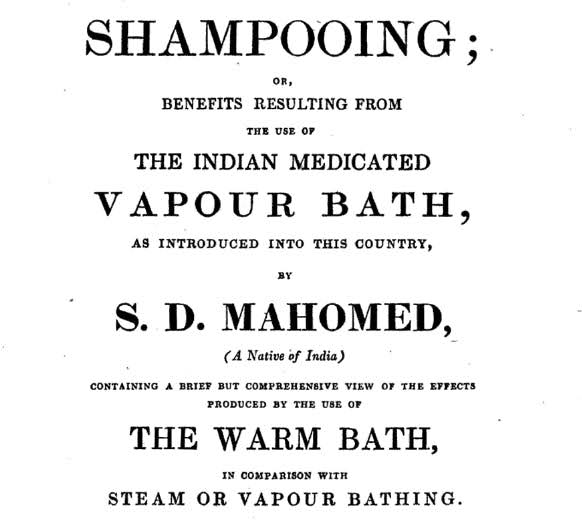
In his advertisements, Mahomed presented shampooing as both exotic and therapeutic, a kind of health cure as much as a luxury. In a way, he planted the seed that would later bloom into the shampoo we know, though it would take another century and a half for soap to join the party.
From Massage to Suds
So, how did a word about pressing muscles turn into one about scrubbing scalps? Over time, “shampoo” in English expanded to mean not just the act of massaging, but also the washing of hair, especially when that washing involved a vigorous rub. The massage aspect faded into the background, and by the mid-19th century, “to shampoo” was being used for cleaning hair in the literal, soapy sense.
Commercial shampoo as a product didn’t appear until the early 20th century, when chemists developed liquid formulas specifically for hair. Before that, people in the West often used ordinary soap or flakes, which were harsh and left hair dull, while Indians had been using herbal pastes, oils, and powders for centuries. Nevertheless, the new “shampoos” were gentler and left hair more manageable. By then, the original Indian massage meaning was almost entirely forgotten.
A Global Shampoo Family Tree
Interestingly, the word “shampoo” kept its connection to massage longer in other parts of the world. In modern Hindi, “चाँपो” (chāmpo) still means “press” or “massage,” and “चंपी” (champī) is a head massage. In some Southeast Asian countries, “shampoo” or a similar-sounding word can still mean a massage treatment.

What’s in a Name? Apparently, a Whole Spa
Today, “shampoo” is almost universally associated with hair washing, complete with a variety of scents, promises, and prices. The original link to Indian wellness culture is mostly invisible to modern consumers. But the next time you lather up, you’re unwittingly borrowing from a centuries-old tradition of massage, colonial encounters, and cross-cultural word travel.
And if you’ve ever enjoyed a scalp massage at a salon before the rinse…well, that’s a tiny echo of shampoo’s origin.
Word Origin Corner
Shampoo’s journey is a neat example of semantic shift, where a word changes meaning over time. Here, it went from “massage” (no soap) → “hair massage” (maybe soap) → “hair washing” (definitely soap). A similar thing happened to “broadcast,” which once meant scattering seeds in a field and now mostly means transmitting TV or radio signals. Or my favorite: the shift of “nice” from meaning ignorant and foolish to pleasant.
Language changes not just because of cultural trends, but because people borrow words, stretch their meanings, and sometimes rinse them under warm water until they become something new entirely.
The Takeaway
Next time you shampoo your hair, you can smugly inform anyone within earshot (and I certainly don’t do this): “You know, this used to mean a massage in colonial India.” Whether or not they thank you is another matter, but at least your hair will be clean, your scalp will be happy, and your vocabulary will be a little richer.

Further Reading / Sources
- Brighton Museums – “Sake Dean Mahomed: Brighton resident and Regency entrepreneur”
- AramcoWorld – “The Shampooing Surgeon of Brighton”
- Wikipedia – “Shampoo (massage)”
- Bioinformation (PDF) – “Impact on Hydrotherapy: Contribution by Sake Dean Mahomed
- Medium – “How an Indian Brought Shampoo to the English in the 1800s!”
 An American in Kerala