In Kerala, mango season begins quietly. A lone vendor sets out a crate of glowing yellows and blushing oranges, sometimes tinted with stripes of green, by the roadside. Then another vendor appears. And another.
By May, mangoes seem to be everywhere: stacked in pyramids on rickety tables, carted down alleyways in woven baskets, filling the dining room with a pungent sweetness as they ripen.
We wait to buy from a vendor near our home, who snags the best variety, the best quality. He and his wife also make a mean mutton soup.

It’s easy to take this fruit for granted. There’s mango season, and there’s the waiting season, like the steady ticking of a clock.
But too often, we separate ourselves from the journey our foods make, from the backbreaking farm labor and the heartbreak of a lost mango crop in a too-rainy summer season, to the post-workout smoothies of the privileged.
And if the fruit itself has such a fraught journey, then what about the word mango? Where did it come from? Which cultures first used it? How did it weave its way into English?
From Malayalam to the World
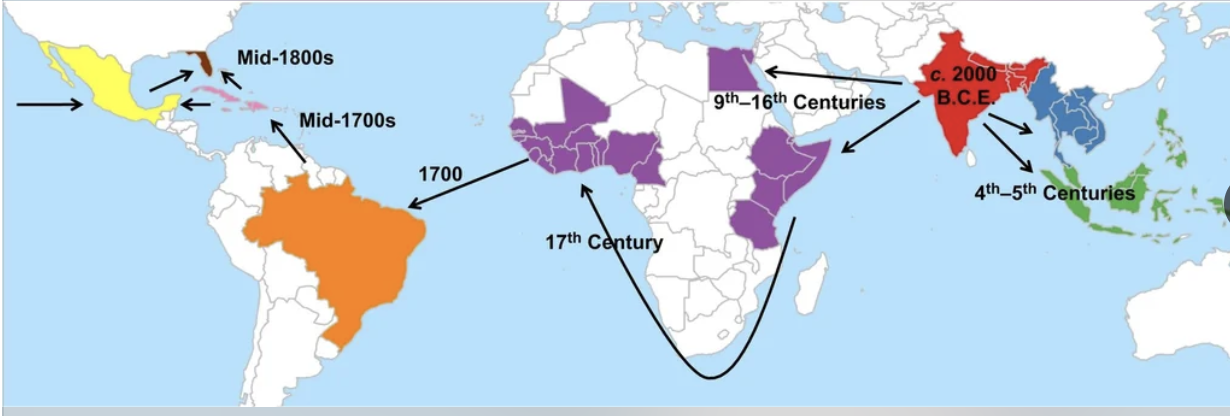
The English “mango” traces its roots to māṅṅa (മാങ്ങ) in Malayalam, the language of Kerala. But the journey of a word is rarely straightforward. Some scholars suggest the Portuguese first heard it from Malayalam speakers, while others argue it came from Tamil neighbors, who called the raw fruit māṅkāy (மாங்காய்) and the ripe fruit māmpaḻam (மாம்பழம்). Since Malayalam and Tamil are both part of the Dravidian language family, it’s difficult to pinpoint which word sailed west first.
Portuguese traders adopted it as manga during their 15th-century spice voyages. By the time they established a sea route to Europe, Arab traders had already been exporting Kerala’s spices, and words like naranga (orange), for centuries.
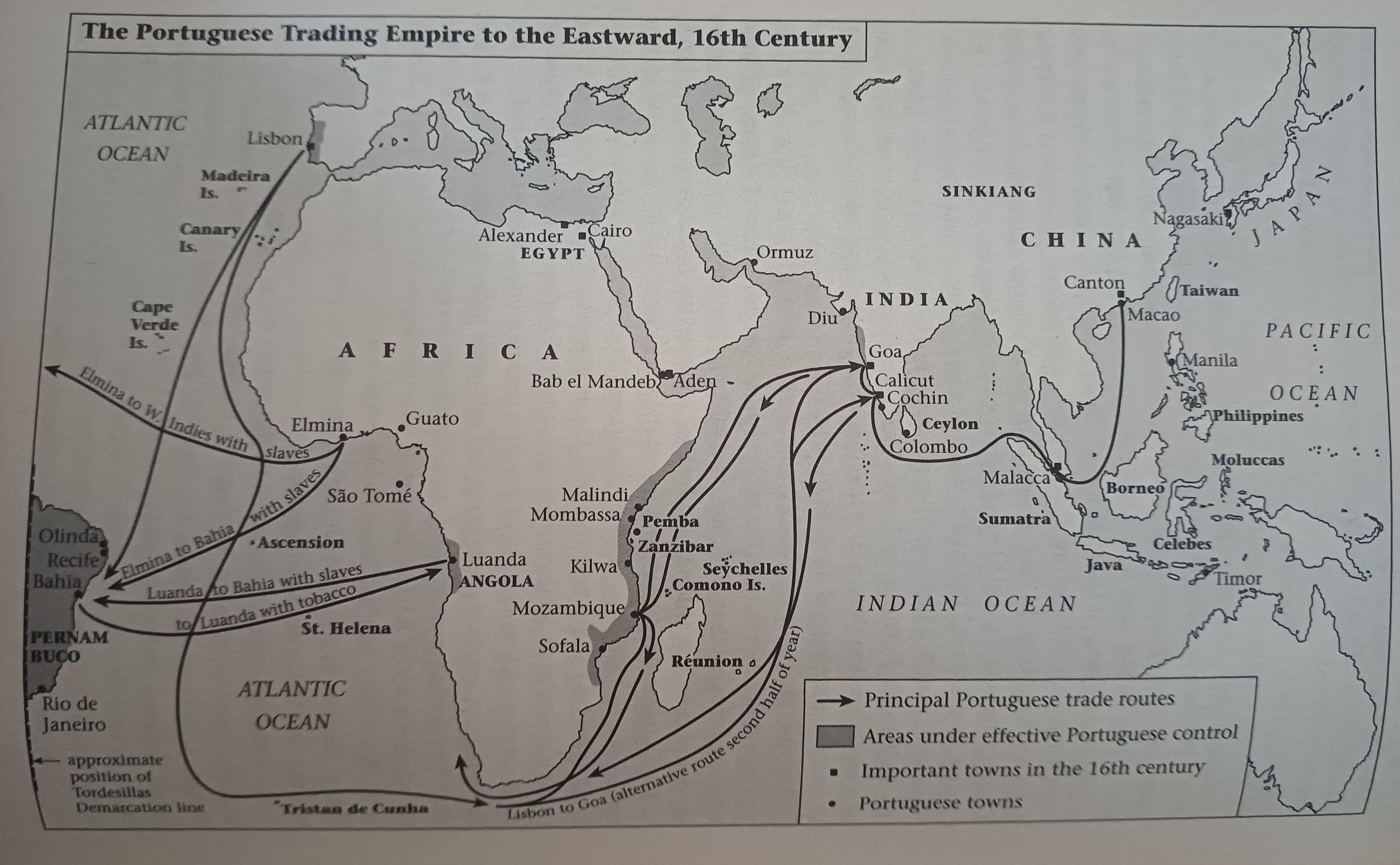
In 1498, Vasco da Gama succeeded where Columbus had failed: charting a direct sea route to India and landing on the Malabar Coast. This was likely when māṅṅa first touched a Western tongue.


As with most colonial encounters, da Gama’s arrival brought more than trade. It brought upheaval; an attempt to claim, exploit, and remake a culture the Portuguese barely understood. Like every empire, they left behind a tangled legacy: trade routes that changed more than cuisines, and violence that uprooted lives.
From 1498 onwards, manga traveled into French and Italian, then into English, with the first recorded use of “mango” appearing in 1582.
For a time, “to mango” was even a verb in colonial America, meaning “to pickle” (which is why some places still call green bell peppers “mango peppers”).
Today, we’ve untangled mangoes from pickles and peppers. But the legacy of colonialism is not so easily resolved.
But there’s a truth here worth admiring: a tiny word like māṅṅa can travel across oceans and centuries, weaving itself into English. Every time someone says “mango” in London or Philadelphia, they’re unknowingly speaking a fragment of Kerala’s language.
Language as a Recipe Book
But it isn’t just mango. Our English-speaking homes and kitchens are stocked with Indian words carried along trade routes and colonial corridors:
- Chutney (from Hindi chaṭnī)
- Curry (from Tamil kari)
- Bungalow (from Hindi banglā, meaning “Bengal-style house”)
- Shampoo (from Hindi chāmpo, “to knead”)
Each word is an artifact, if only we take a moment to wonder. They are small testaments to hands that stirred, chopped, hammered, and kneaded across centuries, reminders of the histories and people behind them.
The Journey Hidden in a Word
Now, when I bite into a mango here, I taste more than its layered sweetness. I hear the word’s journey too, spoken first by a Malayali vendor in Trivandrum, sailing across seas and empires, and scrawled on a supermarket sign in Pennsylvania.
Language carries more than meanings. It carries fragments of history and home, especially for those caught between roots.
For Further Reading (if you crave more about erstwhile empires and their legacies):
- Empires of the Word: A Language History of the World – Nicholas Ostler.
- Inglorious Empire – Shashi Tharoor
- The international swap trade in useful words, BBC Magazine (2014)
- Arrival of Portuguese in India and its Role in Shaping India – Col. (Dr.) D. P. K. Pillay (2021)

 An American in Kerala