I got a manicure in a nice salon for my birthday. I’d promised myself I’d quit a 41-year-old habit. Then I glanced out the window.
Red Umbrella
The technician submerges my hands in the lavender water to soften my chewed-on skin. My fingers flex, the water stings the wounds. Each sore a metronome of the hum inside. Too ashamed to relax, I do everything but close my eyes. Count towels. Searching for pores, maybe a frizzy tendril on the model’s giant face beside me. I crane my neck to look out the window, and I see a red umbrella, swaying like a heartbeat in the brutal sun. The umbrella tips, and I see him, his sign, a small board cupped in his left hand: MEALS. The sunlight shifts, and my own reflection hovers in the glass. The technician massages chamomile lotion into my skin. “For relaxation.” “Is the AC temperature okay, ma’am?” I stare at the man and his red umbrella until he walks out of sight. I ask for red polish on my fingertips. I ask the technician if she gets to visit her family, so far away. I murmur another apology about my fingers. The red polish, cured under light.
A dragonfly shimmering in the morning light, bright hues of red across its body, paused in front of me on the footpath. And then another stopped by. They didn’t stay long, enough to appreciate their precision and to notice several dragonflies soaring overhead and around me.
Dragonflies rest in tall grass. And when there isn’t any, they cannot rest and frantically fly overhead in droves, searching for a place to land their worn bodies. I learned this the last time the grass was cut short and there were hordes of dragonflies in the air. Here I thought I was witnessing a miracle of nature. But it was only that their beds were destroyed.
I don’t want to compare insects to humans who have lost their homes to war or savagery from their fellow man. But when entire cities are flattened, razed like the tall grass, I can see why people behave like these dragonflies. Circling, swirling, racing to find a new place to rest. Except the shimmers are their tears, and the bright red hues are streaks of blood.
This essay concludes a series on India Syndrome, Orientalism, and spirituality seeking in India. You can find Part 1 here and Part 2 here.
Bigger Than Ourselves
I moved to India with zero expectations, no desires for spiritual awakenings or anything of that sort. And thirteen years later, I’m still here because this is where my child was born, where my neighbors know my name and my sense of humor, where the routines have become mine. I am not wandering from ashram to ashram or following any grand calling other than life itself. But I have changed nonetheless.
My transformation arrived in delivery rooms, crowded markets, long queues, and building a life far from the culture I grew up in. The miracle of India, I’ve learned, lives less in Himalayan peaks and more in the ordinary, in showing up day after day for the slog, but most of all, for people.
Still, from a distance, I can recognize the hunger that brings so many travelers to India. The ones who arrive with notebooks, Instagram reels, and expectations of sudden insight. In the U.S., where I grew up, so many of the places that once held people together have frayed. Church pews are emptying. Neighborhoods exist where people barely know each other. Even restaurants and parks feel quieter. Life often takes place inside private boxes: house, car, office, gym. Even leisure feels like something that is purchased. In that emptiness, it makes sense that people book yoga retreats or chase India as an idea. They want something communal and bigger than themselves. That longing isn’t wrong. It’s very much human.
Outward Journeys, Inward Work
And yet, longing can be deceiving. A retreat or a trek can feel like transformation…until you’re home again, facing the same routines you left behind. The truth is, you can’t import change. A trip might shake you awake, but the work of growth is slower and more ordinary.
For me, it came in small doses: learning patience when I didn’t understand what was happening, finding empathy in a language I couldn’t quite follow, and building a safety net out of friends, neighbors, and aunties. The lessons didn’t arrive in a clap of thunder; rather, they blended into the middle of things I didn’t choose, usually dragging me along, kicking and screaming because I didn’t want to change. I didn’t want to become more self-aware. I didn’t want to learn how selfish I had always been.
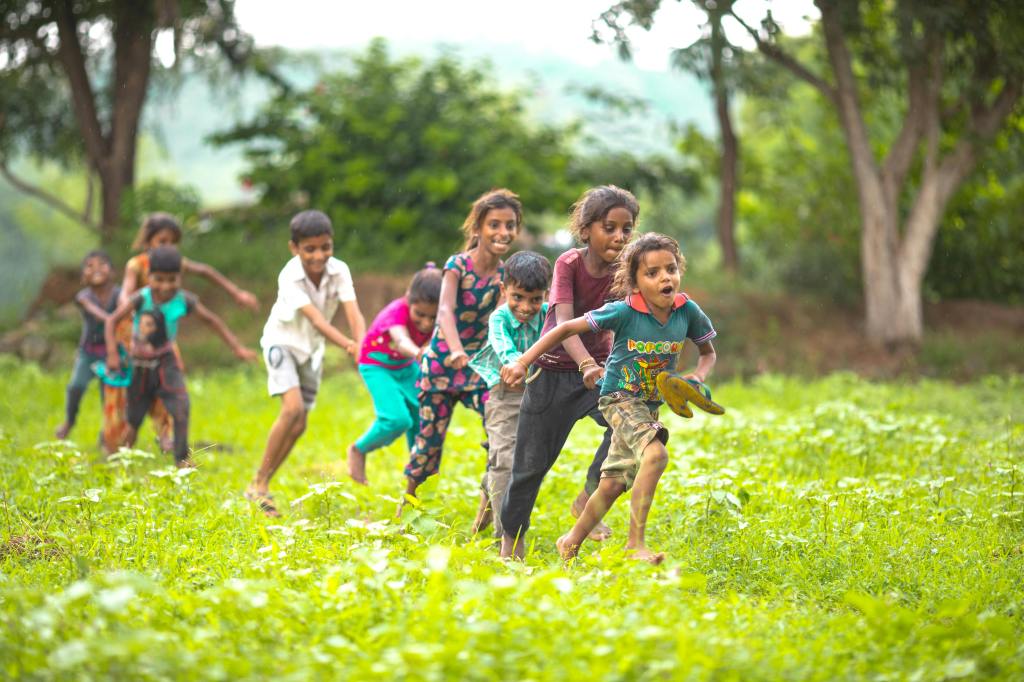
I began to notice something else as well: spirituality here is rarely spectacular. It’s not in ten-day vipassana retreats or sunrise yoga sessions on the Ganges. It’s in the way neighbors check on each other during hard times, in the ritual of quick poojas and prayers in the mornings and evenings, in hobbling together a community meal for a festival, in the patience demanded by long queues and traffic. It’s in the laughter of children playing outside, in the unspoken resilience of people tending to the small tasks of life, extraordinary for Westerners and the privileged, ordinary for many, many others. Living here, you begin to see that the sacred is woven into the everyday routines.
Connection Over Consumption
I’ve come to think the difference is this:
Consumption says, I’ll travel, I’ll pay, I’ll collect my transformation like a souvenir.
Connection says, I’ll keep showing up for people, traditions, and rituals, even when it’s ordinary, even when it’s inconvenient.
The first is exhilarating, but it rarely lasts. The second is much slower and harder to market, but it endures. It’s the work of presence, the steady accumulation of small acts and observations that shape who you become. Meaning is built, piece by piece, in showing up, paying attention, and participating in life as it unfolds.
What I’ve Come to See
So I don’t see myself in the seekers that arrive with plans to awaken some deep wisdom inside of themselves. I see them as people chasing a tale they were handed.
When I began writing about “India Syndrome,” I thought it was a story about travelers who lose themselves and the privilege of foreigners who come here seeking inner peace. But what I’ve come to see is that it isn’t really about India at all. It’s about the longings and aches we carry, the ones that tell us where to look for change. Transformation and finding meaning in life is not escaping into a myth, but staying long enough for your own story to deepen.
Closing Reflection
Edward Said warned in his 2003 preface to Orientalism that the world was hurtling toward a dangerous homogeneity, of differences being flattened by the media and the ways we represent each other. Two decades later, I see a different kind of flattening here, too, in the daily life shaped by global markets and lifestyles. The India that once seemed like a sanctuary for spirituality is not untouched by these. I walk into the mall where we do our shopping, and I am blasted with Starbucks, Burger King, KFC—the list goes on. The contrasts that once felt so stark, between “East” and “West,” between here and there, are becoming more and more blurred as the years go by.
Maybe that’s why I no longer notice as many differences between India and the U.S. Or maybe it’s because I’ve learned to adapt in both places. Either way, the search for “pure” spirituality was always chasing a mirage. The world is blending, converging. And it’s becoming harder to see where one culture ends and another begins.
So maybe what we’re losing isn’t India, or the West, or any particular culture at all. Maybe what’s slipping is our willingness to remain human together—to know our neighbors, to show patience in traffic, to practice rituals that take more than a swipe or a tap. The internet promises us infinite connection, but it mostly sells us distraction, performance, and more consumption. In that sense, India Syndrome isn’t about coming here at all; it’s about the ache we carry when we mistake capitalism for communion. And if there’s any cure, it won’t come from a plane ticket or a retreat. It will come from staying, from choosing presence, from resisting the long drift into sameness by living the small acts that make us human again.
If you do come to India, come to see it for what it is. You might take home some insights, but they most likely won’t last. For “finding yourself,” start at home with what’s in front of you and underneath your feet. Dig your soul deep into the soil. Water it. Tend to it. Let it grow into something truly meaningful. That’s where the real transformation lives.
This essay concludes a series on India Syndrome, Orientalism, and spirituality seeking in India. You can find Part 1 here and Part 2 here.
On my way home one day, I saw a man stop his cycle to feed some street dogs. The scene felt simple, but not quite.
A Few Coins
A man stopped on his cycle along a road not yet flooded with traffic. Thin, well-worn legs. Hands all hard labour: callouses, thick veins, and scars. Yet he cradled a plastic bag, looped around the handlebar.
His guests bounded, all tails and tongues. A welcome only they could give. With a rare tender palm, he patted each head. No rush to the next. From the bag came folded banana leaves, patiently unwrapped. Tails thrashing so wildly, I thought they might lift off toward the mountains.
Then a lantern lit from within. His fingertips shone like torches through dark trees. His eyes burned with a glow that made the world shimmer. A glow I wanted to hold. Here was a parted veil, allowing me a glimpse of what it means to be human. But then I blinked, and he was just a man again, gently portioning a meal for his loyal friends. It wasn’t much but it was all.
Opening Note: One of the first things I learned in Kerala was that food speaks to you. When mustard seeds splutter in hot oil, it’s a signal: add the curry leaves, the shallots, the chillies. Over time, I realized language works the same way. It teaches me when to pause, when to listen, and how to name the world with new words.
Tadka (To My Younger Self)
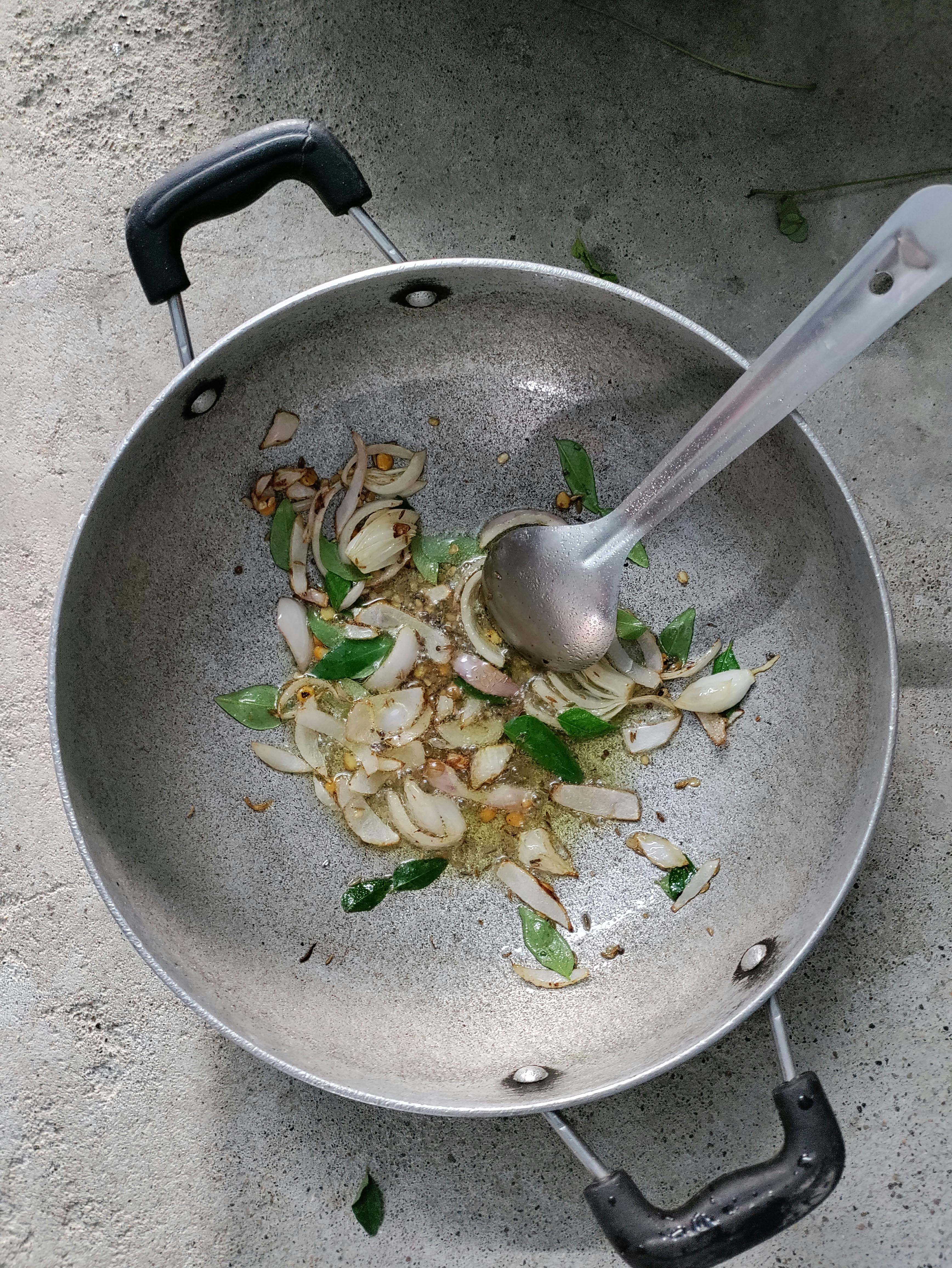
When the mustard seeds splutter, that’s when you add the curry leaves, shallots, and chillies. Call them by their names: kaduk, kariveppila, ulli, mulak. Repeat them, ketto? They will be your anchors later.
You will learn the names of vegetables, fruits, grains first, by accident. Your ears will be covered in scales until they aren’t, and rice, fish, turmeric will become chor, meen, manjalpodi.
Hold on to the astonishment of learning them, tracing the seas they’ve crossed, the shores they’ve touched. Remember, Babel wasn’t a punishment. It was a gift: a doubling, trebling of names for tomato, onion, wheat.
You will want to tell someone about this wonder, but you will feel alone. In India, they will shrug, we know these things only. At home, eyes will glaze over. You’re allowed to marvel anyway, maanasilaayo?
You will still want to shrink into a corner, fear and self-doubt strangling you. But you’ll press forward anyway, shoulders tight, breath shallow, heart pounding.
It’s the same acceptance of terror that gets you through airports, onto planes to your mother, father, and brother, not to relive the old days, but to build new ones– good times, now, with their granddaughter. You learn to do what must be done.
On these visits, you will pass your grandparents’ house. You’ll see black trash bags slumped on the porch, weeds swallowing the yard. Look away if you must.
When you walk inside for the last time, you’ll search for their scent in the damp, unheated walls of late winter. It won’t be there. You will realize: loss doesn’t wait for your return.
And still, the seeds will pop when oil meets flame. The crackle is now, never then. It will not pause for a house that now belongs to someone else.
Fragrance will rise, sharp, insistent. The present will announce itself in smoke and spice.
So listen, mol: you don’t need to live inside what is gone. Stir the heat into what is here. Add the zest. Name things as they are. Find beauty in words for what’s to come. Eat while it’s hot.
Memory will cool soon enough on your tongue.
Closing Note: The crackle of mustard seeds hasn’t stopped surprising me. It’s a small sound, but it reminds me that life is always beginning again, in kitchens, in words, in the ways we honor our pasts.
Why do some Western travelers come to India seeking spiritual transformation, only to vanish, sometimes without a trace?
Some say these disappearances are the result of “India Syndrome.”
Don’t be mistaken. “India Syndrome” isn’t a medical diagnosis. The phrase was coined by French psychiatrist Régis Airault, who worked with embassy staff treating foreigners in India suffering sudden psychological breakdowns. Symptoms are said to include disorientation, delusion, spiritual obsession, and the urge to detach from society, often triggered, Airault suggested, by travel in the subcontinent.
The phrase raises all kinds of red flags for me. It feels too vague, even too condescending. Is it a genuine phenomenon, or just an Orientalist label slapped onto culture shock and untreated mental illness in an unfamiliar culture?
He was an American adventurer, young and smart, who had traveled widely and documented his spiritual journey with real thoughtfulness. In 2016, he vanished in the Parvati Valley after setting off on a pilgrimage with a sadhu. His final Instagram post read:
If I don’t come back, don’t look for me.
He had come to India seeking something: transcendence, transformation, detachment from the self. And then he disappeared, leaving behind a swirl of grief and speculation. Was it a tragic accident? A spiritual quest gone too far? Or was he consumed by the story of India he was already writing?
Stories like his collide with a country already carrying centuries of other people’s projections. To talk about India Syndrome without talking about that projection, about Orientalism, is to miss the bigger picture.
The Shadow Of Orientalism
India Syndrome isn’t new. It’s the latest chapter in a story Edward Said called Orientalism: the West’s longstanding habit of casting “the East” as its mystical opposite. India, in this fantasy, is no longer a country; it’s a metaphor. A place to lose yourself, find yourself, or (in Shetler’s case) vanish trying.
And so the idea of India that travelers bring is often already mythic. It’s been passed down through yoga studios, self‑help books, and colonial literature: India as a spiritual testing ground, a mirror, a maze. But when reality refuses to match the fantasy, the fallout can be intense.
More often than not, it’s white, educated Westerners with the freedom and the resources to wander. The ones who can afford to drop out for a few months, go on retreat, or disappear into the mountains. Choosing India as the backdrop for personal transformation is, in many ways, a consumer decision.
Of course, not every traveler arrives clutching a copy of Eat, Pray, Love, but it’s rare to meet a foreigner completely free of those expectations. The “spiritual East” is so deeply embedded in Western imagination that even those who reject the clichés still bring crumbs of it with them.
There’s a certain privilege in being able to fall apart and then be found. When travelers go missing, embassies get involved. Families launch global searches. Articles are written.
It’s clear to see: When a Western traveler vanishes, it’s a mystery. When an Indian pilgrim goes missing, it’s a statistic. The heartbreak is equal, but the news coverage is not.
Meanwhile, most local voices, such as guides, sadhus, neighbors, police, and even Indian spiritual seekers, rarely appear in the narrative except as background figures. India becomes a stage, not a speaking role.
That raises uncomfortable questions: Where’s the line between spiritual curiosity and exoticism? Between seeking meaning and expecting a place to hand it to you? And what does it mean that so many of these stories treat Indian traditions as if they exist solely for foreigners?
I don’t have neat answers. But I have crossed paths with travelers who seemed to be drifting far from reality.
Not a Mirror, Not a Maze, Just a Country
One early morning, at the front gate of the Dhikala zone in Jim Corbett National Park, Uttarakhand, I noticed a white man leaning against a tree.
At first, I thought he might be a tourist from a nearby resort. But the closer I looked, the less sense that made. His cycle was old and battered. A plastic jug of murky liquid hung from one handlebar. A grimy plastic bag swung from the other. He wasn’t wearing a shirt or shoes.
He spoke to the guards for several minutes, then got his cycle and rode off toward town. “What’s that about?” I asked my husband. “That guy wants to ride his cycle through the park,” he said. “He’s riding it all the way to Rishikesh.”
The guards laughed. Not cruelly, but with the familiarity of people who had seen something like this before. I don’t know if he was a regular, a wanderer, or simply someone too deep in his own creation of India. The kind of figure whose story would be recounted as a quest, while a local doing the same might be dismissed as desperate or unwell.
But that’s the thing about India Syndrome: it’s never about the person who’s actually unwell. It’s about the stories we tell to explain them. A local man cycling barefoot through tiger territory would be called mad or poor. A white man doing the same becomes a seeker, a mystic, or a cautionary tale.
India itself doesn’t cause these breakdowns. But something else does: ages of Western fantasies that have whispered to generations of seekers:
Welcome to India: the cure for whatever you think is missing in your soul.
Up Next: Part 2 – Who wrote that mythical script, and why do we keep performing it?
Somewhere between arrival and departure, I’ve learned to speak in two voices and carry two selves. This is about what happens when neither feels entirely mine.
A Switch | സ്വിച്ച്
This plane window is a signaller. Ready to help me choose myself before we fall to the earth. I am sinking and floating at once, but I look out the window anyway to see which personality to wear after landing.
Grey bypasses, skyscrapers, concrete squares: all holding their breath. The switch flips to America.
A quilt of coconut palms, low white buildings, the switch flips to India. My head wobbles before the plane touches down.
Later, I learned there’s a word for this. I protested: I don’t do this. Not me. And the man I spoke to replied, “Oh, but I think you do.”
In India, I’m more reserved, yet I speak more. Slowly. Enunciating. I use words like: lift – boot – lorry – brinjal – petrol. I say Ruh-vi, not Raaah-vi. I roll my Rs and move na – nja – nna through my tongue and lips. I clench my fists in frustration when the word is right there, drifting, italicized, in my mind, tucked under my tongue when I try to speak.
And then in America, when I’m with people who knew me once, but not quite. When nostalgia rolls in as thick as the fleece blanket that keeps me warm in stark Pennsylvania winds, I’m more open, but speak less. I speak quickly, slurring my words: “Didja eat yet?” I smile hellos and how are yous to perfect strangers, but never pushing beneath: “Friend, how is your heart?” or “Is your father doing okay?”
“You kinda have an accent now,” so I flatten my As again. My voice shifts north into my nose and the words roll out: elevator – trunk – truck – eggplant – gas.
I don’t have to worry about chechis and chettans. Americans like first names, giving us a pretend closeness, like a handshake without eye contact.
Here’s the thing: neither one feels quite right. In India, I wear a mask. I smile when I don’t want to; swallow questions and bite back criticisms because my face marks me a visitor even though I’ve rooted my hands deep in the soil. In America, I wear a wool sweater two sizes too small. I tug at the sleeves, sweating, itchy, chafed but never take it off.
So, who am I? Am I the words spoken to others, what they see: a woman in love, a fool, a brave soul? Or am I something deeper? Or am I none of these?
Am I just a middle-aged woman afraid she will always be brushing the edges, never quite let inside? Am I just afraid that someday I’ll be a stranger in a strange land where I borrowed books from the library and licked ice cream as I walked to the park?
Now, the only home is my daughter’s voice when she tells me the song she and her friends made up; when my husband and I walk into the hovering emerald canopies.
If my skin were peeled away and my chest cracked open: The hush of the monsoon rain washing through the ghats, the whisper of the snow covering the evergreens—
Would you recognize the language of my pulse,
the accent of my blood,
forever stuttering switching tracks until I break the lever.
I don’t deserve the soft mattress I sprawl across each morning. Letting my 40-year joints stitch themselves back together. But most nights, it’s what I’ve said wrong that keeps me awake.
In fact, I would say none of us who have soft mattresses deserve them. We didn’t earn them. Just luck.
We are born lucky. A devoted family, a country not torn to shreds by war. Food in the kitchen; no bloated bellies except when we eat too much junk. So why does sorrow still creep in?
I find the wrong in small, small things, and they sour like curd left to set too long in the heat. They blister my nerves. I become a pulsing mass, pushing past the ammoomma parked sideways in the cereal aisle. Why didn’t I give her any grace?
Why am I so weary all the time? I doomscroll on my phone; cracked tempered glass like everything else I don’t take care of. Doomscroll, what a word. Cakes. Vacations. Drunk weddings. A mother holding her child.
But the child wears black plastic for a diaper. I wonder why I am so weary, weary. The child is all bones and angles, and the face— that same look the Somali children had in the ads on TV when I was small.
And there is nothing more in that moment that I want than to trade places or scream or sledgehammer a car or anything, but not nothing. I want to hold this mother.
Her child will soon die.
And who will comfort her in Gaza, where soft mattresses and full bellies write, “But October 7th, what about that?” “She doesn’t look as starved as her kid?” “Even so, come, Lord Jesus!”
Even so, mercy is a funny thing. We want it for ourselves but not others. I wish my chest didn’t feel like it can no longer cage my heart. Growing, stretching, pulling until it bursts, and I vanish into the rains that flow down the mountains.
But then I blink: back in my living room. My daughter dances, her belly full. Her wobbly arabesque cuts through the thickness in my throat. I don’t deserve this. Even so. I tell her it’s time for bed.
A Note
I’ve been having a love/hate relationship with social media. Mostly hate.
Yet I still find myself checking each app; the colonization of algorithms digging deeper in my brain.
Yesterday, I saw the photo that I believe will be looked at 50 years from now, and people will ask, “Why didn’t anyone do anything?”
And while there are many out there on the front lines doing the right things and the hard things, just as many, if not more, of us are just too comfortable.
Myself included.
Unfortunately, I made the universal mistake of checking the comments on the photo.
The absolute least I can do as a human being right now is not leave comments whatabouting a woman whose child is near death. Or questioning her appearance. Or praying for the end of the world.
When I saw the photo, I immediately thought of La Pietà.
A lamentation of an innocent. A mother mourning alone.
I don’t have any answers or advice other than to say this:
There is no justification for starving and bombing children.







 An American in Kerala