Opening Note: One of the first things I learned in Kerala was that food speaks to you. When mustard seeds splutter in hot oil, it’s a signal: add the curry leaves, the shallots, the chillies. Over time, I realized language works the same way. It teaches me when to pause, when to listen, and how to name the world with new words.
Tadka (To My Younger Self)
When the mustard seeds splutter, that’s when you add the curry leaves, shallots, and chillies. Call them by their names: kaduk, kariveppila, ulli, mulak. Repeat them, ketto? They will be your anchors later.
You will learn the names of vegetables, fruits, grains first, by accident. Your ears will be covered in scales until they aren’t, and rice, fish, turmeric will become chor, meen, manjalpodi.
Hold on to the astonishment of learning them, tracing the seas they’ve crossed, the shores they’ve touched. Remember, Babel wasn’t a punishment. It was a gift: a doubling, trebling of names for tomato, onion, wheat.
You will want to tell someone about this wonder, but you will feel alone. In India, they will shrug, we know these things only. At home, eyes will glaze over. You’re allowed to marvel anyway, maanasilaayo?
You will still want to shrink into a corner, fear and self-doubt strangling you. But you’ll press forward anyway, shoulders tight, breath shallow, heart pounding.
It’s the same acceptance of terror that gets you through airports, onto planes to your mother, father, and brother, not to relive the old days, but to build new ones– good times, now, with their granddaughter. You learn to do what must be done.
On these visits, you will pass your grandparents’ house. You’ll see black trash bags slumped on the porch, weeds swallowing the yard. Look away if you must.
When you walk inside for the last time, you’ll search for their scent in the damp, unheated walls of late winter. It won’t be there. You will realize: loss doesn’t wait for your return.
And still, the seeds will pop when oil meets flame. The crackle is now, never then. It will not pause for a house that now belongs to someone else.
Fragrance will rise, sharp, insistent. The present will announce itself in smoke and spice.
So listen, mol: you don’t need to live inside what is gone. Stir the heat into what is here. Add the zest. Name things as they are. Find beauty in words for what’s to come. Eat while it’s hot.
Memory will cool soon enough on your tongue.
Closing Note: The crackle of mustard seeds hasn’t stopped surprising me. It’s a small sound, but it reminds me that life is always beginning again, in kitchens, in words, in the ways we honor our pasts.
When I first moved to Kerala, the one question people asked most was, “Do you like the food?” I didn’t know the importance of food for Malayalees at the time, so I felt confused why people asked that so often. I guess they thought the taste would be super alien to me since I grew up in the States. White rice is too spicy for us, know what I mean?
Of course I loved the food. The aromatic spices, the heat, the tang – it was heaven for my tastebuds. But I was always the odd duck in my immediate family. I liked seafood; no one else did. I liked jalapeños and black olives; no one else did. So it didn’t surprise me that I started enjoying Kerala food right away.
Kerala cuisine is, in general, based around three staples – rice, fish, and coconut. All meals will use at least one of these, if not all. It makes sense these would be staples because Kerala is a tropical, coastal state with paddy fields as far as the eye can see.
But one thing I’ve noticed is that every time I Google “best Kerala foods,” “best South Indian foods,” or any variation of the sort, the lists contain the following: idli, dosa, payasam, appam and stew, parotta and beef, karimeen pollichathu, and pazham pori (banana fritters). And I am always irritated because I know there are superior dishes out there. I’ve eaten them! I’ve cooked them!
Good food is endless here. So I decided to make my own list, including some unsung heroes of Kerala cuisine.
My Top 10 Fave Kerala Foods
1. Uttapam
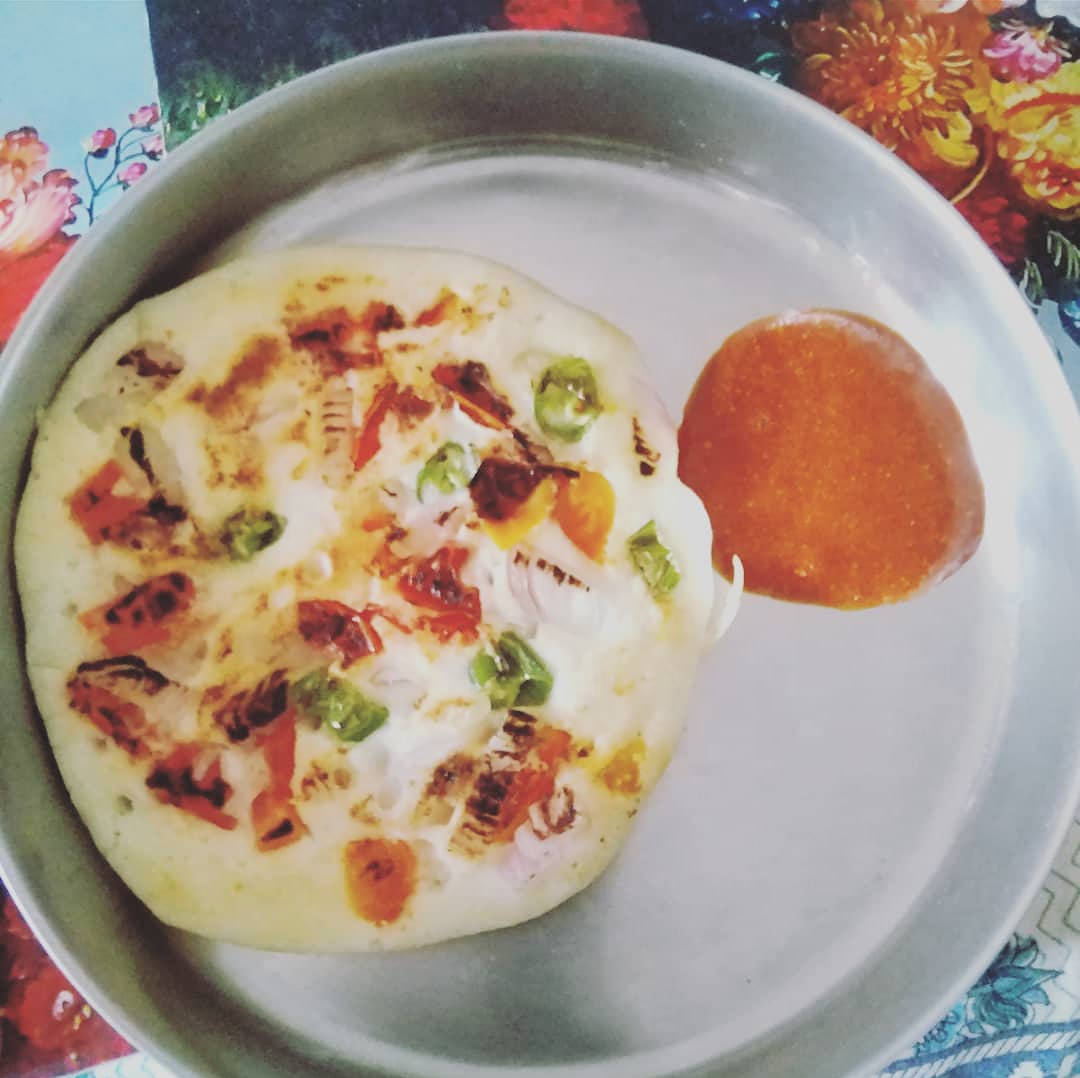
Known in Kerala as oothappam, uttapam is a close relative of the famous dosa. If you ask me (and since this is my list), I think uttapam is the superior rice-based breakfast food. Since I am the only person in this house that likes uttapam, I don’t get to eat it often.
I’ve jokingly referred to uttapam as Kerala-style pizza. It is basically a thick, soft, savory pancake topped with vegetables (mainly onion, tomato, and green chili). You can eat it with sambar and chutney, but I prefer to eat it plain. It’s delicious enough on its own.
This was my first try making it for myself.
2. Anchovy and Sardine Fry
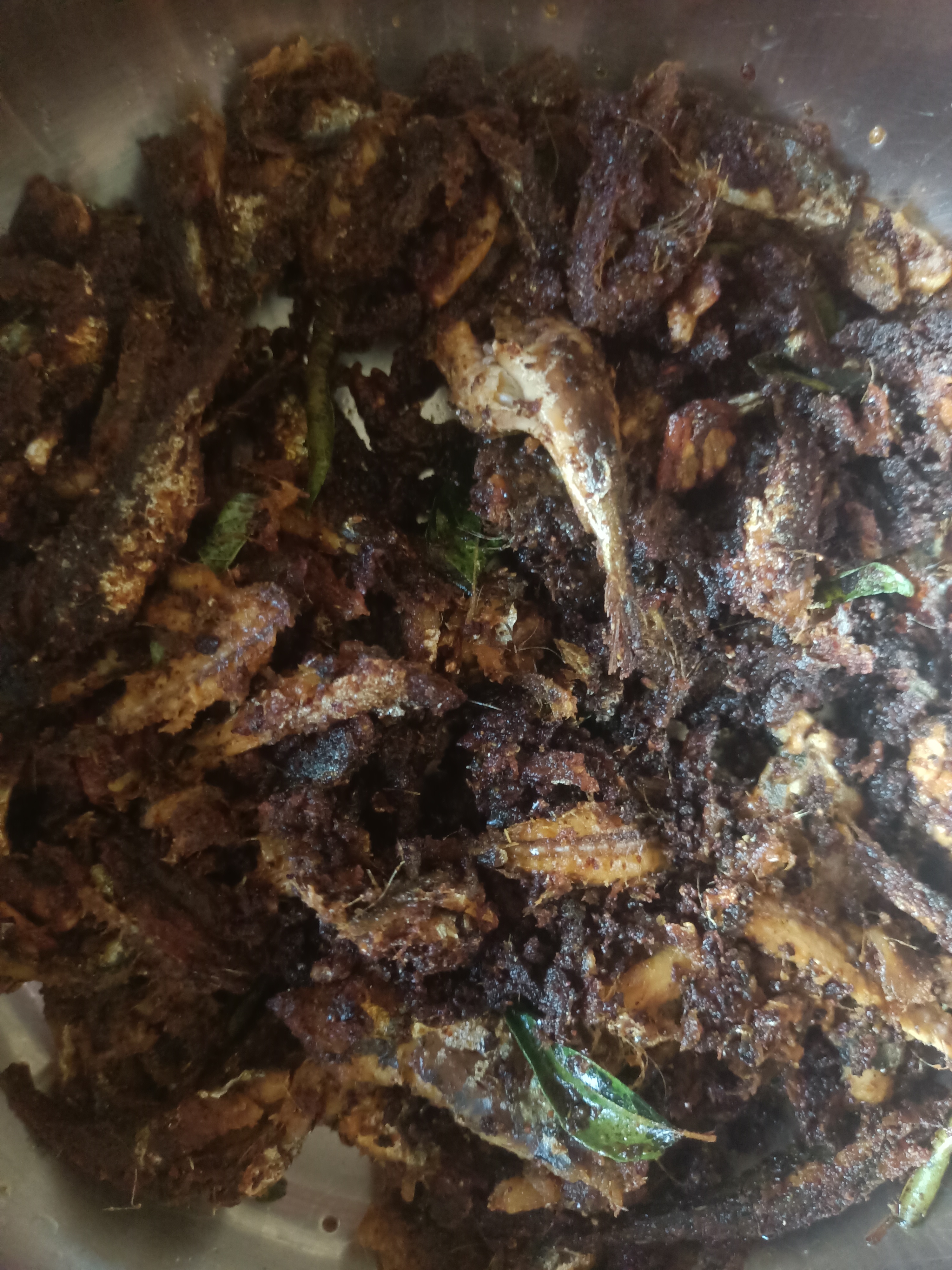
While uttapam is a rare treat for me, nettholi (anchovy) and mathi (sardine) fry are eaten at least twice per week. The fish are cleaned and marinated in a paste made from turmeric, black pepper, red chili, and salt. Then, they are fried until crisp, or if you’re me, until they are almost burnt.
I am not sure what makes these so delicious. But man oh man, couple fish fry with some Kerala red rice, pulissery, and mango pickle, and it is *chef’s kiss.* Man, I’m hungry already, and it’s not even lunchtime!
Nettholi/Anchovy fry
3. Thoran
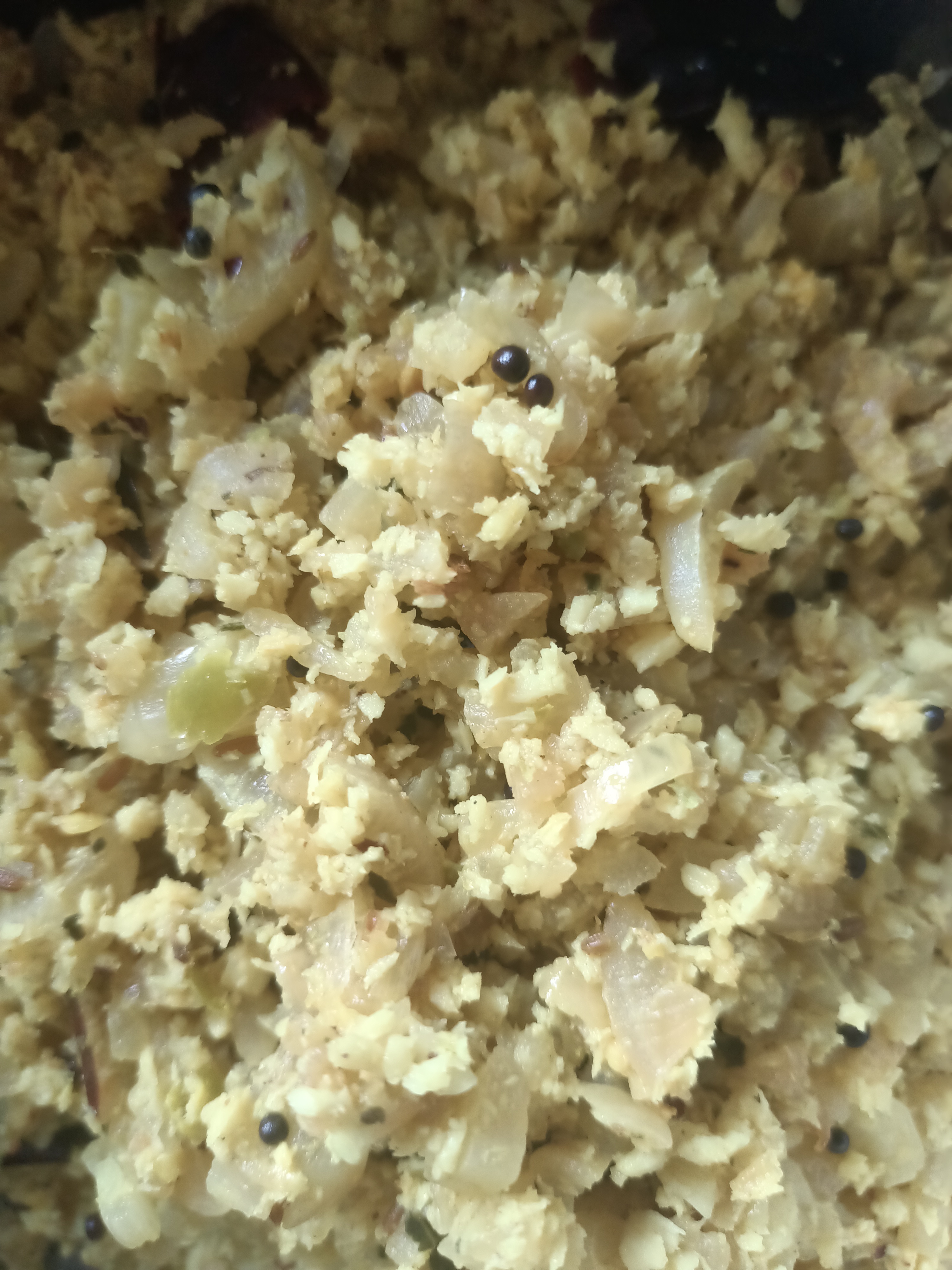
Thoran is a savory dish made from any vegetable you can think of and coconut. The vegetable is diced up, the coconut is grated, and they are both stir-fried to perfection with turmeric, cumin seed, and salt.
I have several types of thoran that I love – cheera (red spinach), beetroot, green beans, banana flower, and chakkakuru (jackfruit seed). Thoran is a dish you will find during meal time at least every other day in many households.
As ubiquitous as this dish is, I had a hard time finding it on any “best Kerala foods” lists!
This is none of my favorites. It’s radish thoran. Still delicious.
4. Ghee Rice/Neychoru
Ghee rice is self-explanatory. It’s made using a short-grained rice and ghee. However, whole spices like cinnamon, cardamom, cloves, and star anise are added for flavor, and the rice is topped with fried cashews, raisins, and onions. For me, the best part of this dish is the fried onions. Just hand me a plate of those please!
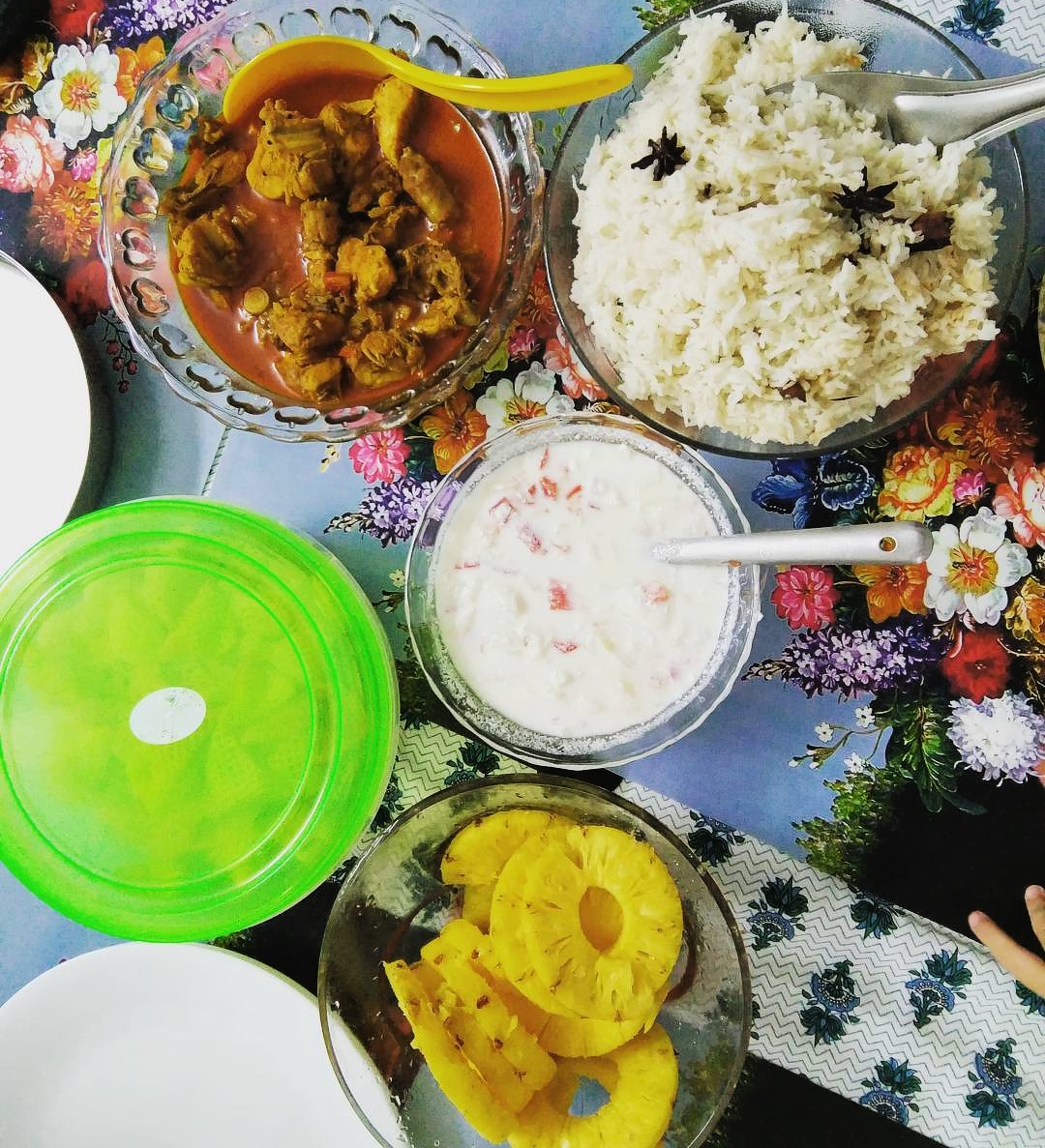
Let me pat myself on the back – I’ve perfected this dish. I received praise for my neychoru every time I make it. I serve it with chicken or mutton curry, raita, pickle, and papadum.
My famous ghee rice is in the top right corner.
5. Bitter Gourd/Pavakkai Fry
Way back when I was in my first trimester and sick as a dog, I didn’t want to eat anything within a hundred-kilometer radius of our Calicut home. Nothing sounded good, and everything smelled terrible. One day I worked up a small appetite and asked Zac to bring me a veg meal from a nearby restaurant. By some small miracle, they served pavakkai fry in my meal that day, and I ate every last bite.
Pavakka, or bitter gourd, is a contentious vegetable. People either love it or hate it. It does have a bitter taste even after it’s cooked. I can eat pavakka in any type of recipe, but this one is my favorite. Similar to the fish fry, it’s marinated in a masala paste after slicing. Then it’s fried until it’s crispy. It’s normally eaten along with rice.
My daughter, who hates most vegetables, loves this recipe.
6. Pulissery
Pulissery, also known as moru curry, is a curd-based curry. It can be made with only curd or with things like ash gourd, pineapple, cucumber or taro root. It’s usually tempered with mustard and fenugreek seeds, dry red chilis, shallots, curry leaves, and turmeric.
This is one of my favorite accompaniments for rice. But I could drink pulissery on its own. It’s that good.
7. Brinjal Fry, South Indian Style
I’m not entirely convinced this is a pure Kerala dish, but I’m including it. Brinjal, or eggplant, is much smaller here than in the US. I find it tastes better, but I’m unsure if it’s the vegetable itself that’s better or if it’s the preparations.
Anyway, this dish is made by slicing the brinjal, and then marinating it in a masala paste (see a theme yet?). It’s then fried until the edges are crisp, and the centers are soft. This is one dish I don’t make often because I eat them until they’re gone. Even if it’s in one meal. I have no shame.
8. Kappa and Meen Curry
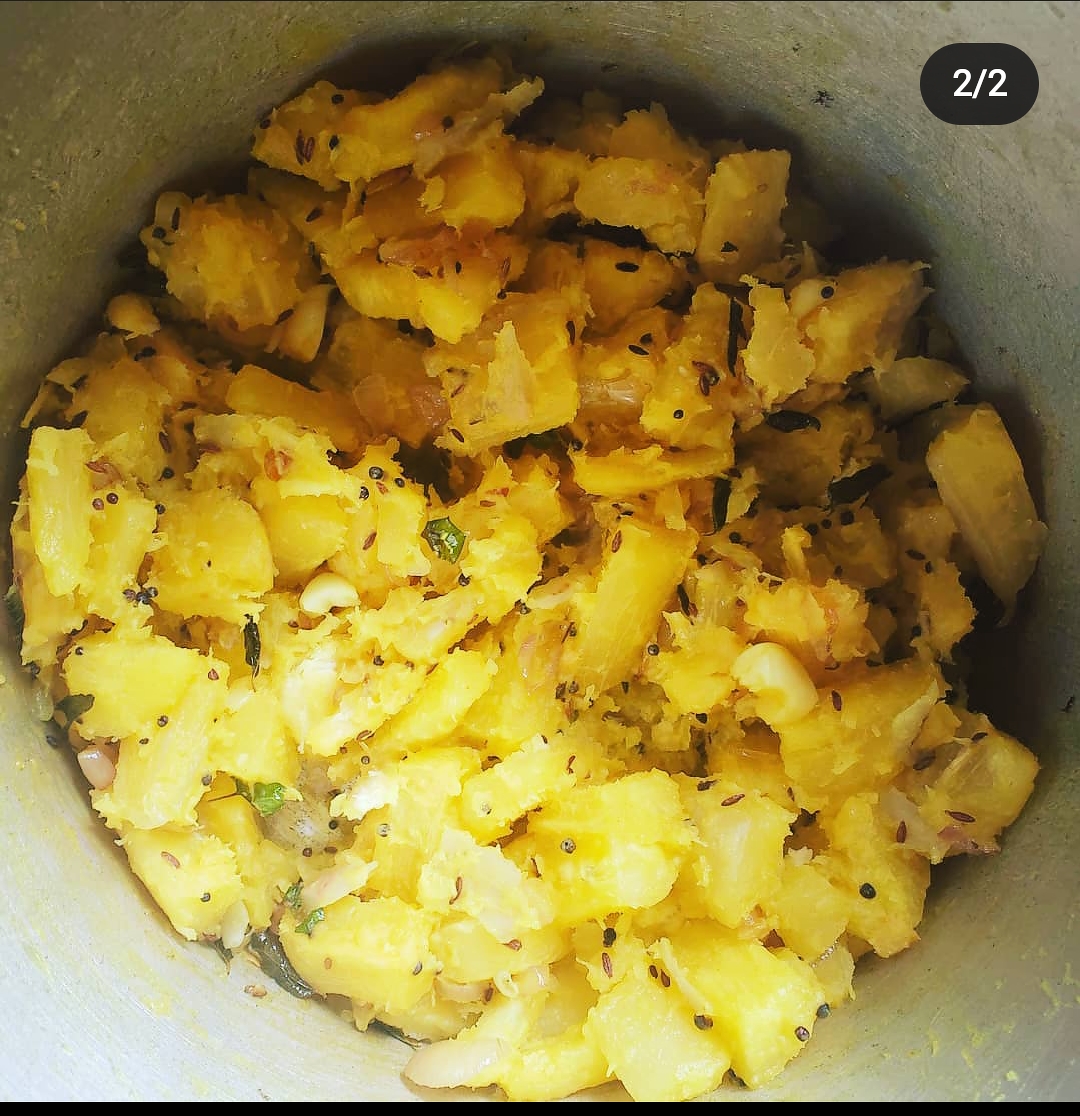
Okay, THIS is a popular dish, and one you will see on the “popular Kerala foods” lists. Many years ago, kappa, also called cassava, was considered a poor man’s food, but you’ll now find it in almost every five-star buffet! The cassava is boiled, mashed, and cooked along with coconut, mustard seeds, dry red chilies, and curry leaves.
Kappa is served with all kinds of curries, but I think the best combo is with red fish curry. It’s another one of those tangy, sour, and spicy curries that I adore, and I go back for seconds, thirds, or fourths of this delicacy!
Kappa and meen curryKappa on its own
9. Rasam
For sure, this dish didn’t originate in Kerala, but it’s consumed so widely in the state that I consider it part of local cuisine. I remember drinking rasam for the first time in a dingy Calicut canteen. I watched the locals throw their heads back and down the liquid, so I thought, “Hey, why not?” I lifted my steel cup and chugged the rasam, and my body went into brief shock. How could a soup pack so much flavor?
Like many recipes here, there are a few variations of rasam, but it almost always includes tamarind, black pepper, cumin seed, garlic, and coriander leaves.
Even though it’s more of a winter dish, I’ll down glasses of rasam on a hot summer day. I power through the sweating that comes post-drinking. I can’t get enough of the spicy, sour curries!
10. Thalassery Biryani
I love all kinds of biryani, so I had to put this on the list. Thalassery biryani is a special type of rice dish from Thalassery town in north Kerala.
Unlike most biryanis, which are made using basmati rice or another fragrant long-grained rice, Thalassery biryani is made with a short-grained rice called Jeerakasala.
Similar to neychoru, this biryani is cooked with lots of ghee, but then the rice is layered with cooked meat (chicken, fish, mutton, beef, etc.) and masala, and sealed so the flavors of the rice, meat, and masala blend together. It’s then topped with my faves – fried onions, cashews, and raisins.
One of the best biryanis I’ve ever had was from a little Thalassery biryani shack in Trivandrum. I tried a fish biryani that time. Everything aligned for that meal – the spices were just right, the amount of ghee was perfect, and the rice was neither too dry nor greasy.
One Dish That I Hate:
1. Puttu
I never felt more validated than when I read a story in March 2022 about a boy who wrote an essay on how much he hates puttu. Same, buddy, same. While the boy says it “breaks relationships” (I can only imagine!), I won’t go quite that far.
Puttu is always found on those “must try Kerala foods” lists, and I don’t get it. I have tried it in every possible way, and it’s not for me. It’s dry. The texture is gritty. And it tastes like paper. Sorry, Malayalees, please don’t kick me out (I also hate jackfruit)!
What are your favorite foods, whether they are from Kerala or elsewhere? What foods do you hate so much you want to toss them out the window when you see them? Let me know!
Well, you did it. You packed up and shipped off to another country; your dreams of wanderlust coming true. Soon enough, weeks or months have passed, and you’ve settled into a routine. But things aren’t as fun as you’d hoped.
Your bathroom looks weird, beds and pillows are too hard or soft, and the grocery store doesn’t carry anything you like. The climate is too hot or cold. It’s exhausting trying to do anything official where no one speaks your language. Everyone else’s concept of time is different from yours.
These are small problems, but small seems huge when you’re away from what’s familiar. Before you know it, homesickness creeps into your stomach.
A lot of blood, sweat, and tears goes into living overseas. You need to break down your beliefs and values, maintain your boundaries, cry a lot, and laugh more than you cry.
Believe me, I know. I’m going on a decade here in Kerala, and my physical and emotional changes careened through ups and downs. I never had any desire to live in another country. I was content to live in or near Pennsylvania for the rest of my life. Well, life had something else planned for me.
When I arrived in Calicut, I was a starry-eyed newlywed, thrilled to live with my husband. Not one thing about India bothered me. Giant cockroaches? Fine. All-day powercuts? Bring it on.
Then our daughter was born, and I ran face-first into a cultural wall. Everything I found endearing became an imposition, and I went into an “I’m here on a long vacation” mindset. Over time, I pulled away from that thought and grew to love my life. Now, I can’t imagine living anywhere else but Kerala. No matter where I am, I’ll leave a piece of my heart here. It’s my home.
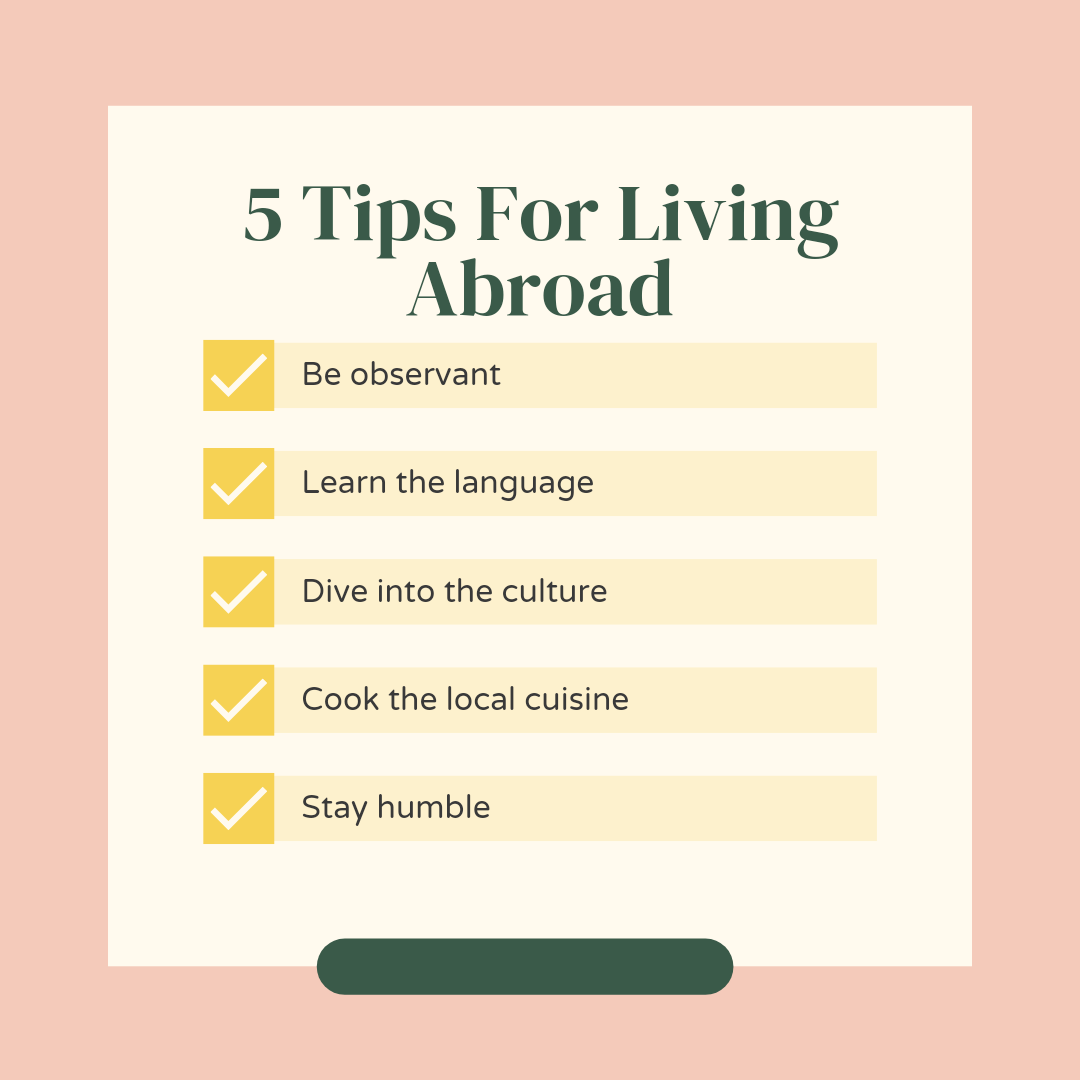
But it wasn’t until recently that I figured out how I fell in love with Kerala. There are a few definitive things I did that made me feel like I now belong here. So, for the sake of anyone plunging into a new culture, I’m giving the few tips that helped me the most.
1.) Be observant.
When moving to a new country, this is the best piece of advice. Observe people. Check out their behaviors. Watch what they’re doing, but even more importantly, watch what they’re not doing. I learned so much about how to behave in India by shutting my mouth and observing.
Some things I learned: eating with my right hand and without utensils, not crossing my legs when I’m visiting someone’s home, replacing handshakes with head nods when meeting someone. These are small things, but people notice when you do them differently.
2.) Learn the language.
You knew this was coming. I’m not telling you to only learn to communicate with people. That is, of course, the biggest benefit to studying a new language. You create and deepen new connections with native speakers.
Learning the language blows your world wide-open. You can understand a new slew of music, movies, jokes, and idioms. For me, few things have been more satisfying than finally understanding Malayalam memes.
Learning a new language has a host of benefits. It stimulates the brain, stalls cognitive decline, and boosts creativity! So get signed up for a class and start your language journey!
3.) Throw yourself headfirst into the local culture.
Throwing yourself into anything when you’ve moved to a new country seems like the last thing you want to do. But please trust me on this one. It gives you an enormous appreciation for your new home. Take a dance class, a singing class, an art class. Pick something and try it, even if you’re terrible forever.
Learn the history of the art form. Attend a local performance or exhibition. You won’t regret it.
As for me, I’ve written before that I learned (and am still learning) mehndi. And right before the pandemic, I started Bharatanatyam lessons, which I love, love, love. Both have rich histories, and I gained new admiration for all mehndi artists and Bharatanatyam dancers.
4.) Cook the food. This, my friends, is what pulled me out of my cultural adjustment funk. When you cook the local cuisine, you tie yourself to much more than the food itself. You become connected to history, language, and relationships.
Recipe by recipe, I restored my self-esteem by perfecting a huge part of Malayalee culture – their food. Pride wells inside when I hear a Malayalee say, “Brittany is an expert in making biryani.”
5.) Stay humble. Over the years, I’ve lost count of how many times I’ve culturally screwed up. It’s fine to make mistakes! But when Zac would explain how to avoid issues in the future, I’d rear up and demand why I had to change my behavior. The answer is rather dissatisfying: Because I had to.
Remaining culturally humble isn’t easy. It requires daily self-reflection: wondering how I can better communicate with and listen to people, and how I can better show my respect. It’s understanding the history and dynamics of where you’re living.
There is no sensitive way to say this, but it is neither your job nor your place to change the society where you live. Instead, amplify the voices of locals and citizens who are already changing things. They have done the hard work and deserve recognition.
I hope no one has read through this and now believes I sit stiff as a board and don’t speak so that I don’t offend anyone. If that was true, I wouldn’t have written this. Around friends and family here, I am totally myself. Frankly speaking, though, I am not the same person as the one who existed a decade ago, and that’s a good thing.
And there you have it. My five main tips for adjusting to a new country. While these won’t solve many other daily frustrations (a whole other ballgame), I hope they help people appreciate their new homes.
Wow, long time, no write, huh? I know in my last post I had promised a few entries on what it’s like for me in India, but I had to step back from that. Like, waaaaaaaay back. The more I wrote, the more miserable I sounded and was becoming because I was picking apart the joy that someone else had found while touring here. Maybe someday I’ll come back to that when I can examine my big, scary India feelings without it affecting me in the present. So much for writing being cathartic.
Today, I’m gonna try to get back to the joy that I’VE found here (I’ve been doing this in my real life for a while now, and it’s working!). And one of those joys is…..Onam. You know, I realized I posted on my Facebook all of these gorgeous photos of pookalams (flower carpets), sadhyas (special meals), parades, games, but I’ve never explained the festival itself. Onam is the biggest festival in Kerala. It’s like Christmas: everybody celebrates it – Hindus, Christians, Muslims, you name it – no matter what they believe, and people start preparing for it far in advance. They have big Onam deals and sales in all the stores. For ten full days, people are pumped to the max about this celebration. Young men excitedly stand in groups in the middle of the road and stop moving traffic to gather donations for the nearby temples. And then Thiruvonam arrives, the culmination of the festival, and literally everything shuts down and people celebrate at home.
We moved way out to the boonies, away from Trivandrum city, about a month ago. On Thiruvonam, we drove into the city to spend the day with some family, and we were shocked at how deserted everything looked. No stores were open, no people along the roads selling fresh vegetables or fish. Total silence….until we came across those who were celebrating. People finish the pookalams (a task that begins on the first day of Onam – Atham) early in the morning in various places along the roads. Trucks, cranes, bulldozers, and rickshaws were trimmed with flower garlands and paper ribbons, but they had no drivers that day. Palm fronds were torn and folded into bows and hung from strings in the villages. And the people themselves were playing games like tug of war, blindfolding themselves and taking swings at clay pots, and musical chairs. They were dancing, laughing, joking, racing. We even came across two guys dressed as leopards? Tigers? We’re not sure, but they were chasing down the few cars that did drive by.
Peacock pookalam!
Peacock and kathakali dancer pookalam!
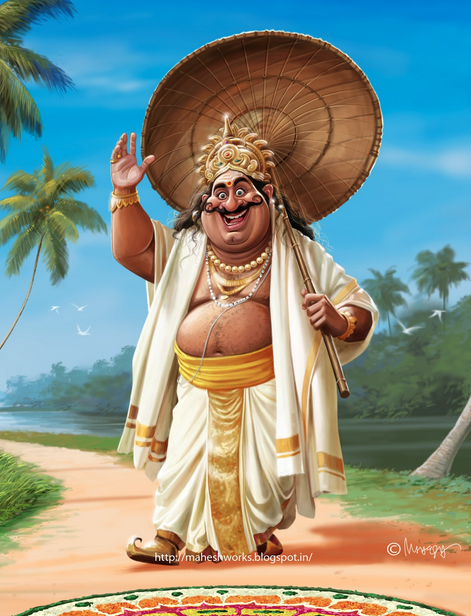
At the center of this festival is King Mahabali. A mythical king who is now depicted as a chubby, jolly looking fellow (sound familiar?), his spirit is said to visit Kerala on every Thiruvonam, and his people wish to show that they are as happy and prosperous as they were when he ruled the land, hence the flowers and elaborate meals.
Yeah, I took this from maheshworks.blogspot.in. This is how he’s portrayed a lot now.
But why does King Mahabali visit Kerala only once a year? I’m sure you’re all dying to know, right?! This legend goes way back – King Mahabali was very generous and wise. Kerala was at its best during his rule – no crime or corruption, no caste system, no poverty but no obscene wealth either, everyone lived in harmony. It was perfect until the gods became jealous of Mahabali’s rule and respect. The goddess, Aditi, went to Vishnu, the preserver God, and asked him to, you know, ‘take care of this Mahabali problem.’ To add some irony, Vishnu was the god that Mahabali worshipped the most! Anyway, Vishnu agreed and disguised himself as Vamana, a poor Brahmin dwarf. Mahabali had just finished his morning prayers when Vamana/Vishnu approached him. Vamana explained he was a simple, poor Brahmin who only wanted some land of his own. Mahabali asked how much land Vamana wanted to which he responded “as much as I can cover with three steps.” Mahabali was shocked that this poor man would ask for so little, but he agreed anyway, not sensing that anything was amiss. But as soon as Mahabali agreed, Vamana grew and grew and grew and grew until he was larger than the earth itself. Vamana covered the earth with his first step and the heavens with his second, but then he stopped and said, “Where shall I take my third step?” And Mahabali knew he had to do something or this man was going to destroy the world, so he bowed as low as he could go and asked Vamana to place his third step directly on his head. Vamana pushed Mahabali into the underworld with his final step, and Mahabali begged for Vamana to show who he really was. After seeing that Vamana was really Vishnu, Mahabali, now banished to the underworld, requested to be allowed to visit Kerala once each year because he was so fond of his people. Vishnu was incredibly moved by the request and the king’s kindness and so he granted Mahabali’s wish and told Mahabali that he would always be dearly loved by his people.
And there you have it. I’m certain I’ve missed details, but I think I covered the basics of the story so everyone reading can understand why Onam is a big deal. People prepare for Mahabali’s return for 9 days, and then on the tenth day, his spirit visits and is pleased to see everybody partaking in large meals (the Onam Sadhya) and playing games and enjoying one another’s company. Just like during his reign.
Homemade Onam Sadhya (minus the rice). There’s a specific order in how things are served. Anywhere from 11 to 34 dishes are prepared. The food should be served on a banana leaf and rice is the center of the meal. Pappadum is always to the extreme left, then a banana, then salt, banana and yam chips, ginger pickle, lime pickle, mango pickle, next are the chutnies (beetroot) and ullikitchadi, cabbage thoran (with coconut), avial (another dish with vegetables and coconut), and another thoran made of beans. After the heaping pile of rice is scooped, dal curry (lentils) and ghee are poured on top. After half the rice is consumed, then sambar curry is poured on the rice. After that, a second round of rice can be taken with pulisseri (curry made with yogurt). Then, if one can eat all that, payasam is served for dessert. Phew!
We got to celebrate Thiruvonam twice is year – once on the actual holiday itself, and then again ten days later when the institute’s, where my husband works, students put on their own celebration. I recorded a lot of the parades and the games, and now our daughter can’t go more than a couple hours without asking to watch “daddy play musical chairs” or the clip of the “drummers and the Tigers.” And I’ve listened to the rhythmic drum beats about 800 times now, but I’m not sick of it yet. She gets so excited watching it, and then explaining to me how scared she was that day when she saw the “tigers” dancing down the hallway.
“Mommy, da tigahs!”
I usually get a huge lump in my throat because I know this is such a blessing for her. Regardless of how torn I may be on my rough days here, she’s is undoubtedly lucky to be sharing in the spectacles of both her mother’s and father’s cultures. Evelyn and I are going to the US next month for three months, so we’ll be there for Halloween, Thanksgiving, and Christmas, so she’ll get to share in MY favorite American holiday traditions. But as usual, I’m split down the middle – feeling horribly guilty about leaving my husband and knowing we will miss him the entire time were gone, but nonetheless excited to eat ALL THE PUMPKIN and wear sweaters, scarves, and boots. And to see my family too – people who always understand my sarcasm and dry sense of humor. People who just, you know, get me. Zac gets me, and probably better than anyone else, but I still don’t know about everybody else. 😂 Before I pour out my heart and soul again with things you’ve read in, I think, every single post I’ve ever written, I’ll sign off. To all you Malayalees out there – I hope I did your festival a little bit of justice. It certainly is exciting to participate in.
I’ve been trying extremely hard not to write an entry like this because I was never sure how people would take it. Heck, I’m not even sure how I’m really taking it. I’m so torn about writing it. Living in India is very conflicting. Some days my heart is so full of being grateful and appreciative for having this opportunity, living in such an ancient culture, seeing the historic monuments and buildings, spoiling myself with massages and such because we can afford it here, living in luxury with our three rooftop swimming pools at our apartment buildings. Other days, I find myself daydreaming about driving my own car down one of Sullivan County’s empty roads. No car horns, no temple music, just blissful silence. Or I get wistful and dreamy about the spacious and roomy parking lots at Walmart ( you will never understand how lucky you are) after a day of frustrated shopping where we can’t find a single parking space at our overly crowded grocery store. Or I wish that I don’t have to second guess what I’m wearing when we go into public, never knowing if it’s fully appropriate for the conservative culture here. Or I wish that I could heat style my hair without it protesting into a ball of frizz or that my make up wouldn’t melt off my face. These may seem like small things, for sure, but when you’re living them everyday, the pangs can get really strong. Most days I’m fine, but some days, I swing from one extreme to the other with me wanting to stomp my feet like a child and scream, “I don’t want to adapt. ANY. MORE.”
I’ve been having waves of homesickness since Christmas Eve, and it’s been getting worse and the waves have been getting a little longer since it’s coming up on a year when I went to the US. In fact, yesterday, I was listening to “California Girls” by the Beach Boys, and I was so stupidly overcome with emotion that I had to sit down at the kitchen table with my head in my hands. So, even though I feel like I’m complaining a bit with this, it just poured out of me and felt sooo therapeutic. I think that even though India overall has been kind to me, it will never accept me as Brittany, wholly American and unchanged. I’ve had to tone down my sense of humor (sarcasm, pretty much), what I wear, how I approach people, how I address people, who I make eye contact with, who I smile at, who I say hello to (which is no one unless I know them). I’ve even had comments on my hair because it’s shorter than what is considered traditional here. The “if you don’t have anything nice to say, don’t say anything at all” mindset doesn’t exist so much here. Good in some ways, and not so good in others.
I’ve been keeping tabs on this thing called the Kerala Blog Express, sponsored by Kerala Tourism, where they bring a group of foreign bloggers to see the best Kerala has to offer. And that’s just it – they’re only seeing the best. As I was reading the latest blog, cheekily titled 12 Reasons to Never Visit Kerala, I felt a huge disconnect between what the blogger had written and my own experience. It’ll be my fourth year here this October, so I’m starting to believe that my feelings and opinions about living here may actually have some clout. I have about 6 to 7 pages handwritten on this topic already, and I’m not even done yet, so I’ve decided to split up all of it in to shorter, easier entries. I’ll probably post once a week until I get it all typed.
First of all, this blogger talks about how hot and humid it is here and how you’re always covered with sweat (all true). But then he talks about how he slathered on SPF 50 when going out on the beaches and hiking, and I just…..I had to stop reading. I can’t even remember the last time I willingly went into the midday sun unless I’ve been 1) under a very large umbrella, 2) in an air conditioned car, or 3) hiding in the shade of a very tall, very broad building. Anyone who lives here knows that being outside between the hours of 10 and 6 is a huuuuge mistake. That’s why many of our beach photos are of sunsets – it’s not for romance. It’s because it’s too stinkin’ hot to go any other time of day. But we have made the mistake of going to the beach in the daytime. More than once, because we kept thinking it would improve each time we went. It didn’t. 10 am – traipsing through hot sand, hot sun, and….ugh….hot air. The beaches are all gorgeous, no doubt, but I think the sunbathers are nuts. No offense. I mean, good grief, it’s so hot outside, why did we think it would be fun? Then, in the car, on the way home, the A/C is cranked to the max, and we look at each other like, “Why did we just do that?” We’re exhausted from the sun, we’ll have to take yet another shower when we get home, and then the rest of the day is shot because we have to rest up since we have real lives to live here. So, yes, the tally – tourist in Kerala: appreciates the heat and sweat and sun and doesn’t miss out on any fulfilling activities because of this; and expat in Kerala: dives into the nearest building like some kind of vampire, counting the hours until I can go outside again. You can’t age me, Kerala sun! NO. WAY.
Never again.
The next thing on this guy’s list that struck me as odd – he writes that Indians have permanent smiles on their faces. To be honest, I have no idea what he’s talking about. With the exception of my husband, who smiles for approximately 85% of his day (not counting his sleepy time), Indians aren’t smilers. In my experience, the average Indian has a very serious, even borderline unfriendly appearance. I won’t even discuss the blatant stares I still get once in a while from people….or maybe I will, who knows where this paragraph will lead me? But appearances aside, Indians are some of the happiest, friendliest people on the planet. Don’t ask me why they’re so happy – they have lots of reasons not to be, so I’m still trying to flesh all that out.
And this friendliness and happiness leads to such unbelievable hospitality. People are so happy and so proud to have you as a guest in their home. And this, this is when Indians smile. I will never forget, on my first trip to India, we visited the Dhobi Ghat slum in Mumbai, and a young man invited our small crew to see his tiny, well kept home – I mean, it was tiny and most of his belongings were covered with the laundry that he was washing for the Mumbai residents. He just stood there with a broad smile on his face, gesturing for us to enter his home, and I’m sure he would have served us tea if we hadn’t been in such a hurry. This poor man would have given us something that he most likely struggled to earn, and he would have done it with a good, genuine heart. I can’t even fathom it – it leaves me speechless.
That man is in the orange shirt.
Well, now that I’ve waxed poetic about the friendliness and hospitality of Indians, I’m going to tell you that it hasn’t been easy at all for me to make friends here. In fact, I didn’t make any friends at all until we moved to this new apartment complex in October 2015. That’s three, count ’em three, years of having no real, live friends to talk to besides my husband. But I remember the days at our old house when I would cry because I was so lonely for just one other female friend. Just one other mom friend, who could at least pretend to understand how destabilizing it can be to be a stay at home mom in a foreign country. Someone who could sympathize with me on the days when I’m feeling a bit homesick and like I’ve lost a sense of my identity – that I have no idea what I’m good at anymore. Someone who could understand why I protest keeping a maid and a cook because, while it’s extremely difficult to maintain a home here with all the dust and dirt, I didn’t like that my self-sufficiency was completely shredded. It’s taken me a long time to find those people.
And it’s not that there weren’t any women around me. I’ve had female neighbors the entire time I’ve lived here. But they were local Kerala women, at least one generation separated from me, and, I felt, an entire world away in values and interests. I vividly remember (because I felt so mortified) sitting in one woman’s home, she had made me tea, and after the initial “what are you preparing for lunch” conversation (topic of choice here), there was nothing but silence because we had no idea how to continue. And as for me, being a bit socially awkward, my brain kicked in to overdrive panic mode – What do I say? What do I say?? WHAT DO I SAY??? And that made it all much worse.
It has gotten easier. I’ve learned by the example of my husband, in those situations, it’s best to ask about family members – as many details as you can about as many members as you can think of. People love to talk about their families. This tactic has very much saved me from any more awkwardness. The tally – Tourist in Kerala: is greeted by smiling hotel representatives and tour guides and then thinks everyone here is constantly smiling and in a good mood; Expat in Kerala: sees and experiences the real deal (which I think, despite my complaining, is the better deal).
I hope I haven’t turned anyone off from visiting India. I promise you – it changes your life in the most unexpected ways. I sound like a broken record because I know I’ve written this before. Like I said, my emotions are always in a constant battle – it’s a duality, much like India itself. The extreme good and extreme bad, extreme wealth and extreme poverty learn to co-exist with each other somehow. People say that you either love India or you hate it when you visit for the first time, and I can assuredly say that it’s possible to love and hate this place in the same breath. This is my experience and mine alone. I’ll be posting the next entry sometime next week. Stay tuned!










 An American in Kerala