I moved to Calicut, India, in October 2012 to be with my husband. Moved to Trivandrum, India, in 2013 and have been here ever since. Ten years in, I feel like I'm still navigating my space in Malayalee culture. But one thing is certain - Kerala will always keep a piece of my heart.
I got a manicure in a nice salon for my birthday. I’d promised myself I’d quit a 41-year-old habit. Then I glanced out the window.
Red Umbrella
The technician submerges my hands in the lavender water to soften my chewed-on skin. My fingers flex, the water stings the wounds. Each sore a metronome of the hum inside. Too ashamed to relax, I do everything but close my eyes. Count towels. Searching for pores, maybe a frizzy tendril on the model’s giant face beside me. I crane my neck to look out the window, and I see a red umbrella, swaying like a heartbeat in the brutal sun. The umbrella tips, and I see him, his sign, a small board cupped in his left hand: MEALS. The sunlight shifts, and my own reflection hovers in the glass. The technician massages chamomile lotion into my skin. “For relaxation.” “Is the AC temperature okay, ma’am?” I stare at the man and his red umbrella until he walks out of sight. I ask for red polish on my fingertips. I ask the technician if she gets to visit her family, so far away. I murmur another apology about my fingers. The red polish, cured under light.
We have built civilizations between us, but we have never been able to build a wall high enough to keep out the dark.
A Darkness You Can Feel
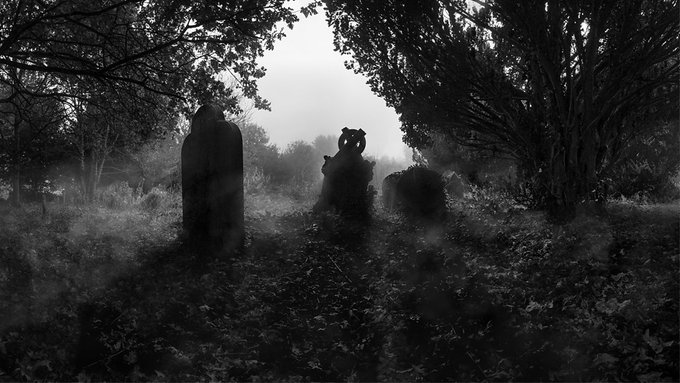
A few weeks ago, we went for a night drive along the shadowy roads near our campus. When I say it’s dark, I mean a darkness so complete it’s difficult for most Americans to imagine. The thick canopy of trees swallows every fragment of ambient light.
In that thickness, I noticed something, something that appeared enormous. A pair of glowing eyes and the outline of a huge antler rack floated among the tree trunks.
Surprisingly, my first thought wasn’t “sambar deer,” though that’s what the creature turned out to be. They roam the roads at dusk and into the night; I’ve seen them plenty of times before. But this time, a chill twisted in my gut, and the word “Wendigo” surfaced in my mind instead.
And this got me thinking. What legends, spirits, and spooks reside in these mountains and forests? Are they too different from the ones I have read about and heard among the Appalachian forests and beyond?
So, this Halloween, let’s wander a little, through the misty mountains and red clay roads of the world, to meet these tales who speak in different languages, but murmur the same human fears.
Let’s meet these tales, one by one…
The Woman Who Walks at Night
In northern India, there is the Churel, a woman wronged in life who returns after death, often seeking vengeance. Her appearance is hideous: backward-facing feet, a black tongue, rough lips, and long, lank hair. But don’t be fooled: she can shapeshift into a beautiful young woman, luring men from lonely roads, then draining them of blood or life. By dawn, her victims are found aged and gray.
Sketch of a Churel
Their eternal sorrow becomes a weapon, a force of nature that refuses to be ignored.
If that sounds familiar, it should. Across the world, Mexican and Southwestern communities tell of La Llorona, the “Weeping Woman” who searches for her drowned children by the riverside, calling out to travelers who stray too close. Just hearing La Llorona’s cries means misfortune or death for the unlucky person.
Statue in Mexico of La Llorona
These stories echo the pain of women betrayed and silenced by those who failed them. Their eternal sorrow becomes a weapon, a force of nature that refuses to be ignored.
But the night isn’t the only thing to fear. There are also the hungry…
The Hungry Dead
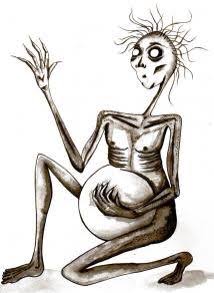
In Buddhist and Hindu belief, there are the Pretas, which are hungry ghosts, cursed with throats too narrow and stomachs too large to ever be filled. They wander unseen among the living, forever searching and eternally unfulfilled.
Depiction of a Preta
…when insatiable greed consumes a person, they are transformed into the very monster they once feared.
Half a world away, among Algonquian peoples of North America, there’s the Wendigo, a spirit consumed by hunger, forever craving human flesh. It roams through the deep winter and forests, possessing unsuspecting humans, including the gluttonous and the starving, and turning them into cannibals.
The Wendigo
The lesson is the same across seas and continents: when insatiable greed consumes a person, they are transformed into the very monster they once feared. It is a cautionary tale written in the pangs of an empty stomach.
And then there are the monsters born not from hunger, but from desire…
The Lover’s Curse
The Yakshi from Kerala folklore
In Kerala, the coastal state at India’s southern tip, they tell of the Yakshi, a beautiful woman with jasmine-scented hair and a smile that hides her true nature. She appears at night under palm trees, asking lonely men for company, then drinks their blood.
…these are women who have been made monstrous through the fears and transgressions of men.
Let’s travel to the American South where they have their own deadly spirits. There’s the Boo Hag of Gullah folklore, who slips into sleeping bodies to ride them through the night, draining the person’s life force and causing them to feel exhausted. And then, we’ll find the Deer Woman, told across many Native American nations (and later found in Appalachian lore), who has dual roles as both protector of women and children and terrorizer of men, luring them to their deaths.
The Boo Hag
The Deer Woman
Each is a story where beauty and danger wrap around each other; a lesson (or warning) that desire can be as perilous as fear.
But beneath this surface lies a more ancient, predictable truth: these are women who have been made monstrous through the fears and transgressions of men. They are the reflections of patriarchal anxieties, where female power and sexuality become deadly.
But we don’t always have to travel so far into the past to find things that terrify us…
The Ghost Who Knocks
A door with “Nale Ba” scrawled across it
In the 1990s, a strange panic gripped Bangalore, India. People began to say a witch roamed the streets, knocking on doors at night. She could sound like your mother, your friend, anyone you trusted. If an unlucky soul answered the door, they would be found deceased soon after. The only way to keep her out was to write “Nale Ba” (“Come Tomorrow”) on your door.
The ancient fears that haunted our ancestors in the forest have learned to knock on our urban doors.
It’s eerily close to the more modern American legends like Bloody Mary, whispered at sleepovers, or the Mothman who appeared before disasters. Every age invents its own ghost, and the city’s concrete replaces the forest, but the uneasiness stays the same.
The Mothman
The Nale Ba legend is a terrifying reminder that our modern world is a thin facade. The ancient fears that haunted our ancestors in the forest have learned to knock on our urban doors.
But it’s not only spooks and spirits that can scare us. There are beings that can shapeshift into or imitate humans…
The Shapeshifter’s Secret
From the tomes of Hindu mythology is the Ichchhadhari Nagin. It is a serpent that can become a woman, taking human form mostly to seek revenge if her lover is harmed. She is ancient, divine, and deadly.
Depiction of a Nagin
…this illuminates the fear of crossing lines between human and animal, good and evil.
To the west, in Navajo tradition, tales of Skinwalkers describe witches who take animal form through forbidden ritual. Misrepresented often in pop culture, they remain one of the most secretive and feared figures in Native belief. They are said to also mimic the voice of loved ones and are even able to possess a human.
Depiction of a Skinwalker
Both of these spirits terrify through transformation, and this illuminates the fear of crossing lines between human and animal, good and evil. But they’re also stories about identity and justice: who gets to decide what form is “pure,” and what happens when that line is crossed.
The Universal Language of Fear
Ghost stories are rarely just about ghosts. They’re about the things a culture struggles to name: grief, injustice, hunger, desire, guilt.
That’s why Indian and American folklore can look so alike.
When we tell these stories respectfully, we’re recognizing that all people haunt and are haunted. Every culture gives its dead a voice, and every voice has something to teach the living.
So this Halloween, maybe the scariest thing isn’t what goes bump in the night. Maybe it’s realizing how alike we all are when the lights go out.
We have built civilizations between us, but we have never been able to build a wall high enough to keep out the dark. And in that primordial dark, we all tell the same stories to make sense of what we cannot see.
As we are between the festivals of Diwali and Halloween, I thought it would be appropriate to do a shorter etymology post.
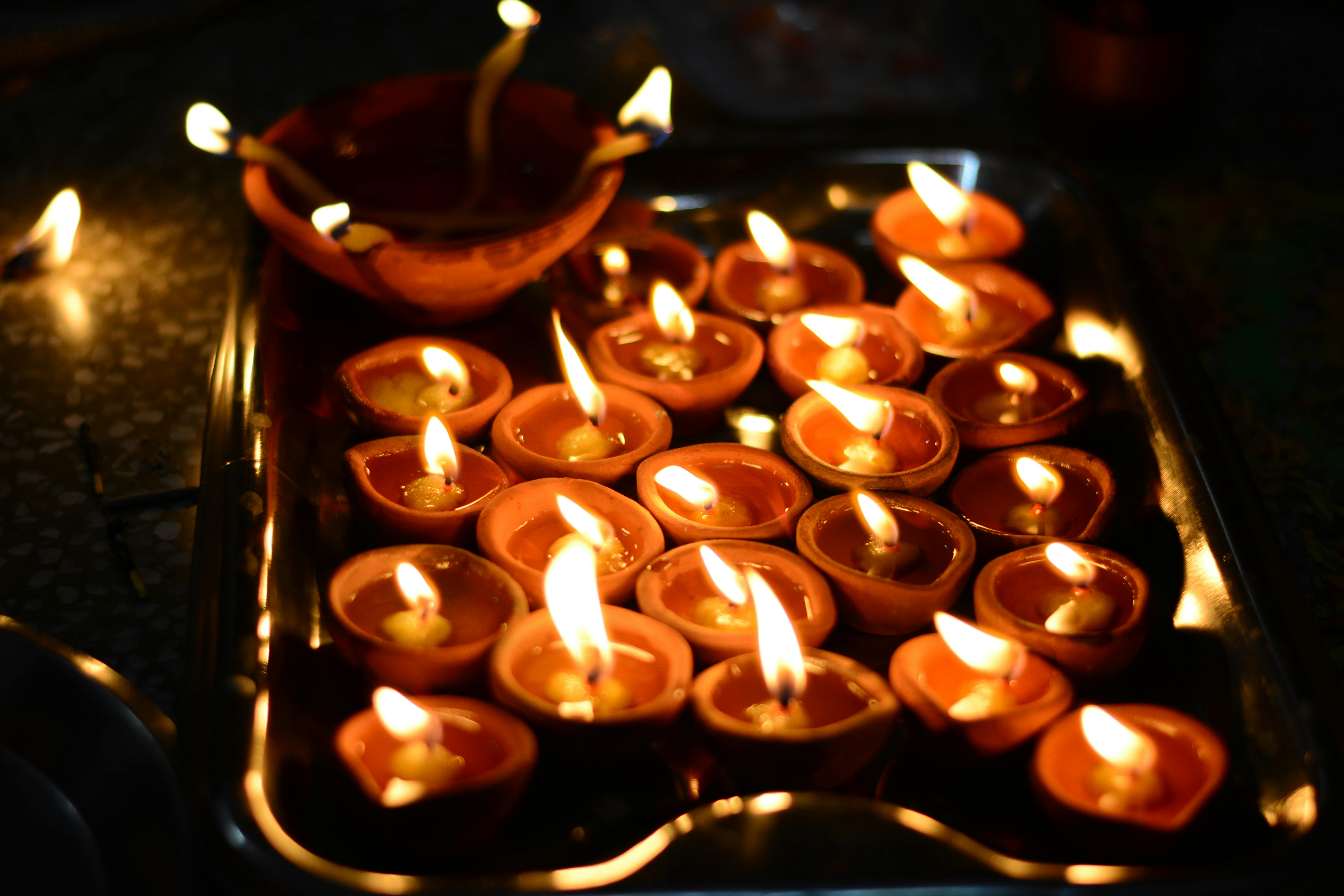
Diwali, the Festival of Lights, celebrates the triumph of good over evil and light over darkness. You’ll find homes lined with diyas and lamps, fireworks and sparklers, and lots of sweets.
Halloween, on the other hand, brings a sense of eerie mystery, with costumes, carved pumpkins, and candy capturing the season’s spookiness rather than light and renewal.
But did you notice what these holidays have in common?
Sugar and candy. But where did these sweet words come from? Hidden in the syrup of gulab jamun and beneath the wrappers of Reese’s pumpkins is a fascinating linguistic journey, one that travels across continents and millennia, from ancient India to medieval Europe, carrying the legacy of trade, language, and humanity’s desire for sweetness.
From Sanskrit to Sugar
Before candy bars or kaju katli, there was śarkarā (शर्करा), the Sanskrit word for “ground or granulated sugar.” Originally, śarkarā referred not to refined sugar but to small, gritty pebbles or crystals. As Indians began refining sugarcane juice into crystalline form (a process perfected in the Indian subcontinent over 2,000 years ago) this miraculous sweet substance took on the name śarkarā.
Through centuries of trade along the Silk Road and maritime spice routes, the word śarkarā took on new forms in new languages. In Prakrit, an ancient vernacular in North India, it became sakkarā, which Persian traders adopted as šakar (شکر). The Arabs carried it onward as sukkar (سكر), and medieval Latin scribes recorded it as succarum or zucarum.
By the time it reached medieval Europe, the word had solidified into Old French sucre and Italian zucchero. From there, English borrowed it as sugar in the 13th century.
So the next time you sprinkle sugar into your pumpkin spice latte or stir it into your kheer, remember you’re using a word that began in Sanskrit and traveled the world through trade and culinary innovation. Every grain of sugar is a speck of history, carrying both the memory of ancient India’s language and its ingenuity.
If sugar is the mother of sweetness, then candy is its offspring. This word also has roots in India, from khaṇḍa (खण्ड), meaning “piece” or “fragment.” When sugar was first crystallized, it often formed into large blocks or shards, which were broken into khaṇḍas, pieces of sweetness.
Persian merchants, who became experts in the sugar trade, adopted the word as qand (قند), meaning sugar or sweet substance. Arabic then transformed it into qandī, meaning “made of sugar.”
This Arabic form found its way into European tongues through the bustling trade of the Middle Ages, first appearing as Italian candito and French candi (as in sucre candi, “crystallized sugar”). By the 14th century, English had adopted the word as candy.
The original “candied” goods were fruits or nuts preserved in sugar, luxury items fit for nobles and festivals. Over time, as sugar became more widely available, candy came to mean any sweet confection. And by the 20th century, it had taken on its modern association: the sugary bounty of Halloween night.
So when a costumed zombie knocks on your door shouting “Trick or treat!” or your aunty sends you a package of soan papdi, remember that even the word “treat” shares roots with trade and exchange. Sugar and candy are just two of the words (and wonders) we’ve borrowed from India.
Each piece you unwrap or spoonful you dissolve in your tea carries a soft echo of its past: fragments of Sanskrit, Persian, and Arabic melted together through centuries of travel and taste. Like sugar, language preserves what it touches, crystallizing memory, meaning, and migration into something still on our tongues. Sweet, isn’t it?
A dragonfly shimmering in the morning light, bright hues of red across its body, paused in front of me on the footpath. And then another stopped by. They didn’t stay long, enough to appreciate their precision and to notice several dragonflies soaring overhead and around me.
Dragonflies rest in tall grass. And when there isn’t any, they cannot rest and frantically fly overhead in droves, searching for a place to land their worn bodies. I learned this the last time the grass was cut short and there were hordes of dragonflies in the air. Here I thought I was witnessing a miracle of nature. But it was only that their beds were destroyed.
I don’t want to compare insects to humans who have lost their homes to war or savagery from their fellow man. But when entire cities are flattened, razed like the tall grass, I can see why people behave like these dragonflies. Circling, swirling, racing to find a new place to rest. Except the shimmers are their tears, and the bright red hues are streaks of blood.
This essay concludes a series on India Syndrome, Orientalism, and spirituality seeking in India. You can find Part 1 here and Part 2 here.
Bigger Than Ourselves
I moved to India with zero expectations, no desires for spiritual awakenings or anything of that sort. And thirteen years later, I’m still here because this is where my child was born, where my neighbors know my name and my sense of humor, where the routines have become mine. I am not wandering from ashram to ashram or following any grand calling other than life itself. But I have changed nonetheless.
My transformation arrived in delivery rooms, crowded markets, long queues, and building a life far from the culture I grew up in. The miracle of India, I’ve learned, lives less in Himalayan peaks and more in the ordinary, in showing up day after day for the slog, but most of all, for people.
Still, from a distance, I can recognize the hunger that brings so many travelers to India. The ones who arrive with notebooks, Instagram reels, and expectations of sudden insight. In the U.S., where I grew up, so many of the places that once held people together have frayed. Church pews are emptying. Neighborhoods exist where people barely know each other. Even restaurants and parks feel quieter. Life often takes place inside private boxes: house, car, office, gym. Even leisure feels like something that is purchased. In that emptiness, it makes sense that people book yoga retreats or chase India as an idea. They want something communal and bigger than themselves. That longing isn’t wrong. It’s very much human.
Outward Journeys, Inward Work
And yet, longing can be deceiving. A retreat or a trek can feel like transformation…until you’re home again, facing the same routines you left behind. The truth is, you can’t import change. A trip might shake you awake, but the work of growth is slower and more ordinary.
For me, it came in small doses: learning patience when I didn’t understand what was happening, finding empathy in a language I couldn’t quite follow, and building a safety net out of friends, neighbors, and aunties. The lessons didn’t arrive in a clap of thunder; rather, they blended into the middle of things I didn’t choose, usually dragging me along, kicking and screaming because I didn’t want to change. I didn’t want to become more self-aware. I didn’t want to learn how selfish I had always been.
I began to notice something else as well: spirituality here is rarely spectacular. It’s not in ten-day vipassana retreats or sunrise yoga sessions on the Ganges. It’s in the way neighbors check on each other during hard times, in the ritual of quick poojas and prayers in the mornings and evenings, in hobbling together a community meal for a festival, in the patience demanded by long queues and traffic. It’s in the laughter of children playing outside, in the unspoken resilience of people tending to the small tasks of life, extraordinary for Westerners and the privileged, ordinary for many, many others. Living here, you begin to see that the sacred is woven into the everyday routines.
Connection Over Consumption
I’ve come to think the difference is this:
Consumption says, I’ll travel, I’ll pay, I’ll collect my transformation like a souvenir.
Connection says, I’ll keep showing up for people, traditions, and rituals, even when it’s ordinary, even when it’s inconvenient.
The first is exhilarating, but it rarely lasts. The second is much slower and harder to market, but it endures. It’s the work of presence, the steady accumulation of small acts and observations that shape who you become. Meaning is built, piece by piece, in showing up, paying attention, and participating in life as it unfolds.
What I’ve Come to See
So I don’t see myself in the seekers that arrive with plans to awaken some deep wisdom inside of themselves. I see them as people chasing a tale they were handed.
When I began writing about “India Syndrome,” I thought it was a story about travelers who lose themselves and the privilege of foreigners who come here seeking inner peace. But what I’ve come to see is that it isn’t really about India at all. It’s about the longings and aches we carry, the ones that tell us where to look for change. Transformation and finding meaning in life is not escaping into a myth, but staying long enough for your own story to deepen.
Closing Reflection
Edward Said warned in his 2003 preface to Orientalism that the world was hurtling toward a dangerous homogeneity, of differences being flattened by the media and the ways we represent each other. Two decades later, I see a different kind of flattening here, too, in the daily life shaped by global markets and lifestyles. The India that once seemed like a sanctuary for spirituality is not untouched by these. I walk into the mall where we do our shopping, and I am blasted with Starbucks, Burger King, KFC—the list goes on. The contrasts that once felt so stark, between “East” and “West,” between here and there, are becoming more and more blurred as the years go by.
Maybe that’s why I no longer notice as many differences between India and the U.S. Or maybe it’s because I’ve learned to adapt in both places. Either way, the search for “pure” spirituality was always chasing a mirage. The world is blending, converging. And it’s becoming harder to see where one culture ends and another begins.
So maybe what we’re losing isn’t India, or the West, or any particular culture at all. Maybe what’s slipping is our willingness to remain human together—to know our neighbors, to show patience in traffic, to practice rituals that take more than a swipe or a tap. The internet promises us infinite connection, but it mostly sells us distraction, performance, and more consumption. In that sense, India Syndrome isn’t about coming here at all; it’s about the ache we carry when we mistake capitalism for communion. And if there’s any cure, it won’t come from a plane ticket or a retreat. It will come from staying, from choosing presence, from resisting the long drift into sameness by living the small acts that make us human again.
If you do come to India, come to see it for what it is. You might take home some insights, but they most likely won’t last. For “finding yourself,” start at home with what’s in front of you and underneath your feet. Dig your soul deep into the soil. Water it. Tend to it. Let it grow into something truly meaningful. That’s where the real transformation lives.
This essay concludes a series on India Syndrome, Orientalism, and spirituality seeking in India. You can find Part 1 here and Part 2 here.
On my way home one day, I saw a man stop his cycle to feed some street dogs. The scene felt simple, but not quite.
A Few Coins
A man stopped on his cycle along a road not yet flooded with traffic. Thin, well-worn legs. Hands all hard labour: callouses, thick veins, and scars. Yet he cradled a plastic bag, looped around the handlebar.
His guests bounded, all tails and tongues. A welcome only they could give. With a rare tender palm, he patted each head. No rush to the next. From the bag came folded banana leaves, patiently unwrapped. Tails thrashing so wildly, I thought they might lift off toward the mountains.
Then a lantern lit from within. His fingertips shone like torches through dark trees. His eyes burned with a glow that made the world shimmer. A glow I wanted to hold. Here was a parted veil, allowing me a glimpse of what it means to be human. But then I blinked, and he was just a man again, gently portioning a meal for his loyal friends. It wasn’t much but it was all.
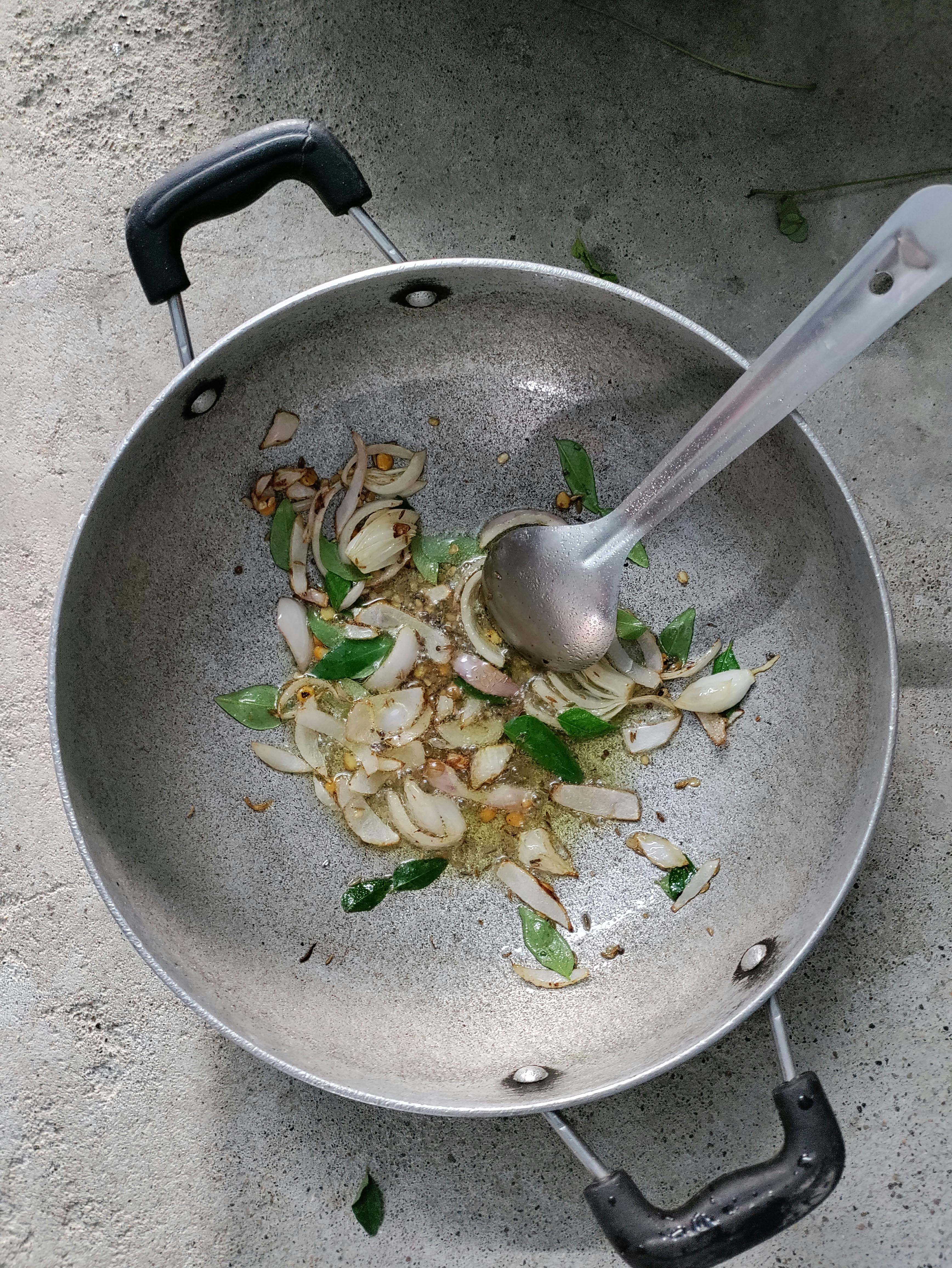
Opening Note: One of the first things I learned in Kerala was that food speaks to you. When mustard seeds splutter in hot oil, it’s a signal: add the curry leaves, the shallots, the chillies. Over time, I realized language works the same way. It teaches me when to pause, when to listen, and how to name the world with new words.
Tadka (To My Younger Self)
When the mustard seeds splutter, that’s when you add the curry leaves, shallots, and chillies. Call them by their names: kaduk, kariveppila, ulli, mulak. Repeat them, ketto? They will be your anchors later.
You will learn the names of vegetables, fruits, grains first, by accident. Your ears will be covered in scales until they aren’t, and rice, fish, turmeric will become chor, meen, manjalpodi.
Hold on to the astonishment of learning them, tracing the seas they’ve crossed, the shores they’ve touched. Remember, Babel wasn’t a punishment. It was a gift: a doubling, trebling of names for tomato, onion, wheat.
You will want to tell someone about this wonder, but you will feel alone. In India, they will shrug, we know these things only. At home, eyes will glaze over. You’re allowed to marvel anyway, maanasilaayo?
You will still want to shrink into a corner, fear and self-doubt strangling you. But you’ll press forward anyway, shoulders tight, breath shallow, heart pounding.
It’s the same acceptance of terror that gets you through airports, onto planes to your mother, father, and brother, not to relive the old days, but to build new ones– good times, now, with their granddaughter. You learn to do what must be done.
On these visits, you will pass your grandparents’ house. You’ll see black trash bags slumped on the porch, weeds swallowing the yard. Look away if you must.
When you walk inside for the last time, you’ll search for their scent in the damp, unheated walls of late winter. It won’t be there. You will realize: loss doesn’t wait for your return.
And still, the seeds will pop when oil meets flame. The crackle is now, never then. It will not pause for a house that now belongs to someone else.
Fragrance will rise, sharp, insistent. The present will announce itself in smoke and spice.
So listen, mol: you don’t need to live inside what is gone. Stir the heat into what is here. Add the zest. Name things as they are. Find beauty in words for what’s to come. Eat while it’s hot.
Memory will cool soon enough on your tongue.
Closing Note: The crackle of mustard seeds hasn’t stopped surprising me. It’s a small sound, but it reminds me that life is always beginning again, in kitchens, in words, in the ways we honor our pasts.
We think of “shampoo” today as the stuff you squirt onto your head when you want your hair to smell fresh again. But the word itself has a backstory that’s richer than an argan-oil conditioner and more surprising than finding out your “herbal blend” shampoo is mostly water.
Left: Sake Dean Mahomed, Indian entrepreneur who opened the famous Brighton “Mahomed’s Baths” in 1814; Right: A colonial “champoo,” no soap involved.
The British Raj and a Massage, Not a Rinse
The story begins in the 18th century, when Britain’s colonial presence in India was at full steam. British traders, soldiers, and administrators encountered not only a dizzying array of spices and fabrics, but also new wellness traditions, including the practice of head and body massages.
In Hindi, the verb chāmpo (चाँपो) means “press” or “knead.” It comes from the Sanskrit root capayati (“to press” or “to soothe”). When British ears caught it, they rendered it as “champoo” or “shampoo,” which referred specifically to massaging the head or body with oils.
Back then, if someone in 18th-century London offered you a shampoo, you’d be melting into a relaxing massage, not a deep scalp wash.
From Hobson-Jobson: A Glossary of Colloquial Anglo-Indian Words and Phrases
From Hobson-Jobson: A Glossary of Colloquial Anglo-Indian Words and Phrases
The First “Shampooing” in Britain
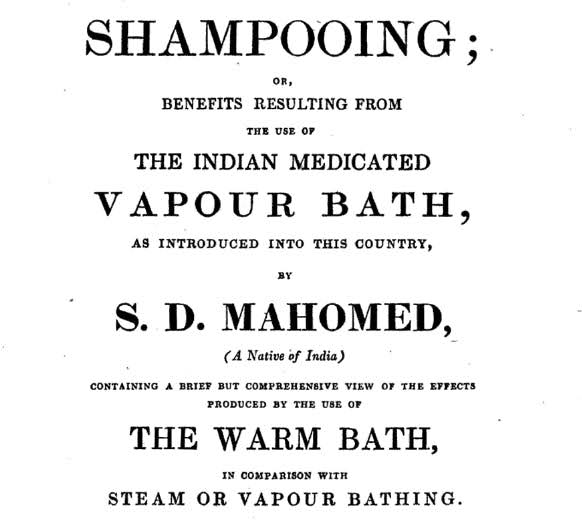
One of the earliest champions of shampooing (in the massage sense) in Britain was Sake Dean Mahomed, an Indian entrepreneur. After an earlier venture, a restaurant called the “Hindostanee Coffee House” didn’t take off, he found fame by establishing “Mahomed’s Baths” in Brighton around 1814.
There, he offered “Indian Medicated Vapour Baths” and “shampooing” services to the fashionable and health-conscious elite. These were elaborate, spa-like treatments involving steam, oils, and massage.
An advertisement for the vapour baths.
In his advertisements, Mahomed presented shampooing as both exotic and therapeutic, a kind of health cure as much as a luxury. In a way, he planted the seed that would later bloom into the shampoo we know, though it would take another century and a half for soap to join the party.
From Massage to Suds
So, how did a word about pressing muscles turn into one about scrubbing scalps? Over time, “shampoo” in English expanded to mean not just the act of massaging, but also the washing of hair, especially when that washing involved a vigorous rub. The massage aspect faded into the background, and by the mid-19th century, “to shampoo” was being used for cleaning hair in the literal, soapy sense.
Commercial shampoo as a product didn’t appear until the early 20th century, when chemists developed liquid formulas specifically for hair. Before that, people in the West often used ordinary soap or flakes, which were harsh and left hair dull, while Indians had been using herbal pastes, oils, and powders for centuries. Nevertheless, the new “shampoos” were gentler and left hair more manageable. By then, the original Indian massage meaning was almost entirely forgotten.
A Global Shampoo Family Tree
Interestingly, the word “shampoo” kept its connection to massage longer in other parts of the world. In modern Hindi, “चाँपो” (chāmpo) still means “press” or “massage,” and “चंपी” (champī) is a head massage. In some Southeast Asian countries, “shampoo” or a similar-sounding word can still mean a massage treatment.
“Discriminating” women use Watkins in this 1920s shampoo ad.
What’s in a Name? Apparently, a Whole Spa
Today, “shampoo” is almost universally associated with hair washing, complete with a variety of scents, promises, and prices. The original link to Indian wellness culture is mostly invisible to modern consumers. But the next time you lather up, you’re unwittingly borrowing from a centuries-old tradition of massage, colonial encounters, and cross-cultural word travel.
And if you’ve ever enjoyed a scalp massage at a salon before the rinse…well, that’s a tiny echo of shampoo’s origin.
Word Origin Corner
Shampoo’s journey is a neat example of semantic shift, where a word changes meaning over time. Here, it went from “massage” (no soap) → “hair massage” (maybe soap) → “hair washing” (definitely soap). A similar thing happened to “broadcast,” which once meant scattering seeds in a field and now mostly means transmitting TV or radio signals. Or my favorite: the shift of “nice” from meaning ignorant and foolish to pleasant.
Language changes not just because of cultural trends, but because people borrow words, stretch their meanings, and sometimes rinse them under warm water until they become something new entirely.
The Takeaway
Next time you shampoo your hair, you can smugly inform anyone within earshot (and I certainly don’t do this): “You know, this used to mean a massage in colonial India.” Whether or not they thank you is another matter, but at least your hair will be clean, your scalp will be happy, and your vocabulary will be a little richer.
Modern ads still promising the world to your hair.
When Justin Shetler disappeared into the Parvati Valley with a sadhu, he was stepping into a story that had been written long before he was born.
The mythical “India” many Western seekers carry in their heads didn’t just appear out of thin air. It’s the result of centuries of writing, painting, sermonizing, and photographing by colonizers, missionaries, and scholars. People who arrived with their own agendas and left with narratives that served them more than the people they described.
From the late 18th century onward, British Orientalists studied Sanskrit texts, Hindu philosophy, and Indian epics, not only to understand them but also to frame them for Western consumption.
When Sir William Jones founded the Asiatic Society in Calcutta in 1784, he fell in love with Sanskrit texts like Shakuntala. But he translated them the only way he knew how—through the lens of Greek classics and the Bible. A few decades later, James Mill wrote his History of British India without ever setting foot there, describing Indian culture as backward and despotic.
Colonial ethnographers romanticized some aspects of Indian spirituality while dismissing others as superstition. William Carey, arriving in Bengal in 1793, translated the Bible even as he condemned Hindu practices, overlooking that Christianity had already existed in India for centuries.
In the mid-19th century, British photographer Samuel Bourne lugged his huge camera into the Himalayas and produced dreamy pictures of temples, sadhus, and misty peaks. Back in London, these images confirmed for readers that India was timeless and mystical, while the realities of famine and politics were conveniently cropped out.
Two stereotypes emerged from all this: India as timeless wisdom, and India as backward chaos. Both were useful to the British Empire and beyond: one justified the “civilizing missions,” the other sold India as a curiosity cabinet.
Spirituality as a Colonial Export
Ironically, many Indian spiritual traditions gained fame in the West through the very structures of colonialism. Texts were translated, performances staged, and lectures given in London or Paris. The most marketable elements—yoga, Vedanta, certain forms of meditation—were cut from their original contexts and pasted as universal philosophies.
By 1893, Swami Vivekananda was in Chicago, dazzling audiences at the Parliament of Religions with his vision of Vedanta as a universal philosophy. A generation later, Paramahansa Yogananda’s Autobiography of a Yogi became a counterculture bible in California. Both men stressed the universality of their philosophies, but their Western audiences consumed them as spiritual “others.”
Meanwhile, at home, the British Raj often undermined or repressed living religious practices, such as closing temples, regulating pilgrimages, and policing gatherings, while happily exporting a purified, aestheticized version of Indian spirituality to the West.
Postcolonial but Not Post-Orientalist
Even after independence in 1947, the West’s appetite for the “mystical East” didn’t fade. It changed branding. The 1960s and 70s brought the Beatles to Rishikesh, hippies to Goa, and the counterculture’s embrace of gurus, ashrams, and psychedelic enlightenment.
The Beatles’ 1968 stay at Maharishi Mahesh Yogi’s ashram in Rishikesh turned meditation into a global craze, while hippies built whole enclaves in Goa. The empire was gone, but the Orientalist script survived, dressed in tie-dye instead of khaki.
Modern yoga studios, mindfulness apps, and wellness retreats are part of the same lineage. In 2014, the UN declared International Yoga Day, celebrating yoga as a gift from India to the world. But by then, yoga studios from Los Angeles to Berlin had already stripped away much of its religious and philosophical roots, selling it as a universal wellness fix. Another neat package, easy to consume.
The industry thrives on a spiritual shorthand: chakras, incense, sunrise chants. These aren’t inventions, but they’re often curated fragments of India, detached from the culture and society that gave them meaning.
It’s not that Western seekers shouldn’t learn from Indian traditions, but the relationship is rarely equal. When spiritual India is treated as a service economy, something to be visited, consumed, and left behind, it becomes harder to see its people as more than extras in someone else’s awakening story.
Why the Script Still Works
The old Orientalist fantasy persists because it answers a Western longing. For centuries, “the East” has been imagined as a place where modern life’s alienation can be cured, where there’s still authentic meaning to be found. India, with its visible spirituality and religions, complicated history, and contrast to Western cultures, fits the role perfectly.
That fantasy colors travel writing and Instagram posts, and it shapes the paths people take. It tells them what to look for, how to frame their experiences, and sometimes, tragically, how far they’re willing to go to live out the script.
On social media, this fantasy can swing both ways. Just as some travelers come chasing enlightenment, others build whole reels around India’s poverty, traffic, or chaos. The effect is the same: India is flattened into a caricature.
Imagine if someone filmed only Skid Row in Los Angeles and claimed it represented all of America. Every country has its shadows, yet India often gets held up as if those shadows are the whole picture. That, too, is a modern form of Orientalism: selecting what confirms a stereotype and ignoring the rest.
And that’s what makes “India Syndrome” such a slippery term. It goes beyond breakdowns in the Himalayas; it’s how the story of India, as inherited from colonialism, can seduce someone into abandoning their own reality.
Some, like Justin Shetler, vanish into that story entirely. Others return home with a few thousand photos and some harrowing stories to tell. Others collect what they believe are epiphanies, which slip into the ether after they slide back into their home’s routine. But even more don’t come at all, choosing instead to nibble on pieces of a 5,000-year-old culture that they feel will patch the void inside them. No matter how it’s done, the same script is still being performed.
The India so many Western travelers arrive seeking is rarely the India they actually encounter. Guidebooks, films, and memoirs have long trafficked in images of a timeless, mystical land—a place to be “discovered” rather than lived in. This is the shadow of Orientalism, the old habit of painting India as exotic, irrational, or spiritual in contrast to a supposedly practical, rational West.
And yet, the story isn’t that simple. Over time, many Indians themselves have adopted, adapted, and even marketed these same images. Yoga teacher training centers, curated “heritage villages,” or pricey retreats by the Ganges all cater to the longing of visitors who want to taste a certain kind of India. For some, these motifs have become a source of pride or income, often pragmatically so. For others, they remain frustrating distortions that compress the diversity and contradictions of the country.
The problem isn’t that seekers come; people have always traveled to India for learning, trade, or inspiration. The problem lies in the hunger for a single story: that India is here to provide spiritual rescue, that transformation is something to be consumed. That desire often blinds travelers to the ordinary ways people here live, worship, and endure.
Even my own experience here has been a constant negotiation with this script—resisting and repeating it, always aware it is much older than me.
Up Next: Part 3 – My time in India, and why so many white travelers chase meaning far away from home.
And if you haven’t read part 1, you can check it out here.



























 An American in Kerala